
GoHighLevel implementation
GoHighLevel, done properly — and priced openly.
aibrevo implements GoHighLevel for agencies and local-service businesses: sub-account and snapshot architecture, pipelines, automations, funnels, and white-label SaaS configuration so you can resell it. GoHighLevel is the one platform where we publish our prices — $500–$4,000 for setup, $4,000–$10,000 for white-label SaaS, $4,000–$12,000 for multi-location.
Who this is for
Marketing agencies and local-service businesses that need GoHighLevel set up right — including a branded platform to resell to clients.
What we implement in GoHighLevel
Snapshot architecture
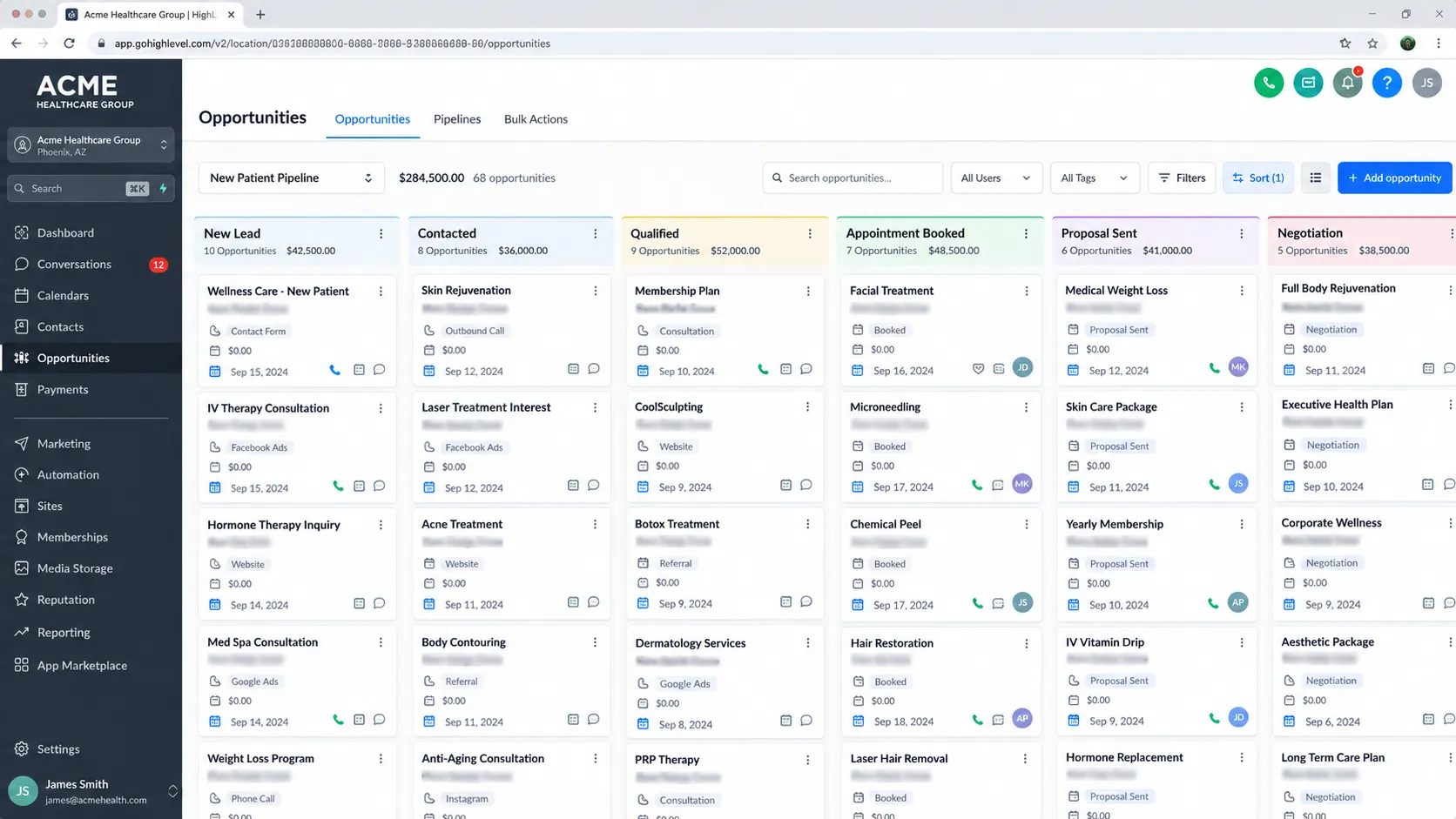
A reusable snapshot with pipelines, automations, calendars and forms your team can deploy per client, built so pipeline stages and tags actually match a real sales process rather than a generic template.
Automations & workflows
Lead capture, nurture, appointment booking, no-show recovery and review requests, built with explicit re-entry and exit conditions so a contact doesn't get the same sequence of texts and emails repeatedly.
Funnels & sites
Funnel and website builds tied into the CRM and automations, so a form submission or booking flows directly into the pipeline instead of landing in a disconnected inbox.
White-label SaaS
SaaS configurator, branded app, billing and onboarding so you can resell the platform, including the SaaS Mode add-on and rebilling infrastructure most agencies don't budget for until after the pitch is already sold.
Multi-location
Sub-account structure, shared assets and central reporting across locations, with each sub-account keeping its own phone numbers and usage budget rather than sharing assets that should stay isolated.
Migration
Import and rebuild from another platform, including automation re-creation, since workflow logic rarely transfers directly between platforms and needs rebuilding against GoHighLevel's own trigger model.
Custom values & merge fields
Custom values, merge fields and dynamic content configured so templates, texts and emails personalize correctly per contact and per sub-account without hand-editing each one.
Reporting & attribution dashboards
Reporting dashboards that roll up pipeline, automation performance and call/SMS activity so you (or your client, in a white-label build) can see results without digging through individual workflow logs.
Phone, SMS and email compliance setup
A2P 10DLC brand and campaign registration for US texting, sending-domain authentication (SPF, DKIM, DMARC) and opt-out handling configured before the first campaign, since unregistered traffic gets filtered and a damaged sending reputation is slow and tedious to repair.
Conversation AI, voice and chatbot configuration
AI-assisted responders and booking bots scoped to a narrow, testable job, with clear handoff-to-human rules and guardrails on what they may say, so an automated reply never makes a commitment the business can't keep.
Calendars, booking and reputation flows
Round-robin and service-specific calendars, reminder sequences that reduce no-shows and review-request automations that trigger only after a completed job, so the front-desk workload drops without spamming customers who had a bad experience.
A typical GoHighLevel project timeline
Phase proportions are typical, not a guarantee — actual timing depends on data volume, integration count and how much of the data model is custom.
- Days 1–3
- Discovery and snapshot build — pipeline stages, tags and triggers adapted to the actual sales process rather than cloned from a generic snapshot, since that adaptation is what separates a snapshot reps actually use from one they work around.
- Days 4–8
- Automation and workflow build with explicit re-entry and exit conditions, funnel and form setup tied into the CRM, and custom-value configuration for personalization.
- Days 9–12
- Testing — confirming workflows don't double-send, sub-account isolation holds if multiple accounts are in scope, and integrations with ad platforms or payment processors work as expected.
- Days 13–14
- Go-live and a short monitoring window. A single-business setup often lands in 1–2 weeks; white-label SaaS and multi-location builds extend to 3–6 weeks because billing infrastructure or sub-account architecture adds real setup time before the first sub-account goes live.
Common GoHighLevel projects
- GoHighLevel setup for a single business ($500–$4,000)
- White-label SaaS platform build for an agency ($4,000–$10,000)
- Multi-location rollout with a shared snapshot ($4,000–$12,000)
- HubSpot or other CRM to GoHighLevel migration
- Niche snapshot build for a specific industry
Where GoHighLevel projects go wrong
Cloning a snapshot without adapting the pipeline stages
Agencies import a generic or purchased snapshot as-is, so the pipeline stages, tags and triggers don't match the client's actual sales process — reps end up working around the tool instead of with it.
Workflows built without a re-entry or exit condition
A nurture workflow fires again every time a contact re-enters a trigger tag, so the same lead gets the same sequence of texts and emails repeatedly and the account looks spammy.
Sub-accounts sharing assets that should be isolated
Templates, custom values or phone numbers get shared across client sub-accounts to save setup time, and a change made for one client silently changes what another client sees.
Not budgeting for usage-based phone, SMS and email costs
GoHighLevel's subscription doesn't include calling, texting or email sending — those run through a separate usage-based wallet — and a busy sub-account running heavy SMS campaigns can rack up real wallet charges well beyond the flat setup fee if nobody planned for it.
Underestimating white-label billing infrastructure
Agencies sell the white-label pitch to a client before realizing SaaS Mode and their own rebilling infrastructure need to be configured and tested first — turning what should be a straightforward reseller launch into a scramble.
Skipping A2P 10DLC registration before launching SMS
A sub-account starts texting leads before its brand and campaign are registered, and carriers filter or block the messages. The workflow looks healthy in the dashboard while customers never receive anything, and rejected registrations take days to resubmit.
Trusting a snapshot's default sending domain
Emails go out from a shared or unauthenticated domain with no SPF, DKIM or DMARC alignment, so deliverability suffers and replies land in spam. Authenticating a dedicated sending domain per client is a one-time setup step that protects every future campaign.
Choosing the wrong plan tier for the business model
An agency buys the entry plan, then needs more sub-accounts, white-labeling or SaaS Mode and has to upgrade mid-project. Matching the tier to the intended business model, resale or in-house use, before building avoids reworking what was already configured.
What does GoHighLevel implementation cost?
GoHighLevel is our one published-price platform: setup $500–$4,000, white-label SaaS $4,000–$10,000, multi-location $4,000–$12,000. Platform subscriptions are separate: GoHighLevel's three core plans in 2026 are Agency Starter at $97 per month (limited to 3 sub-accounts), Agency Unlimited at $297 and SaaS Pro at $497, with those core prices unchanged from 2025 into 2026 (per 2026 pricing guides). Usage is billed on top through a wallet for calling, texting, email and AI, and 2026 guides put a realistic software-and-usage budget anywhere from about $100–$200 per month for a simple DIY setup to $1,500+ per month for an advanced agency deployment, before one-time implementation costs.
Certified across the platforms we implement
- salesforceCertified engineers
- HubSpotCertified engineers
- Dynamics 365Certified engineers
- ZohoCertified engineers
- PipedriveCertified engineers
- monday.comCertified engineers
- AirtableCertified engineers
- GoHighLevelCertified engineers
Our engineers hold certifications on all eight platforms we deliver. We work as an independent implementation firm — no reselling, no white-label, no offshore hand-off.More about the team →
Certifications, and what they actually mean
GoHighLevel doesn't run a formal, independently proctored certification program comparable to Salesforce's — its ecosystem is built more around community expertise, agency case studies and snapshot marketplaces than exam credentials. That means the most useful signal when evaluating who builds your GoHighLevel setup is direct evidence: snapshots they've built, workflows with clean re-entry and exit logic, and — if white-label SaaS is in scope — whether they've actually configured SaaS Mode and rebilling infrastructure before, not just the CRM side. Given how many GoHighLevel "experts" market themselves off a single successful agency launch, ask specifically about sub-account isolation and usage-cost management, since those are the two areas where inexperienced builds most often go wrong. A few more questions separate experienced builders quickly: have they completed A2P 10DLC registration for a client, and what caused rejections; how do they authenticate sending domains; how do they structure snapshots so updates don't overwrite a client's customizations; and what happens to a white-label client's data if they cancel? Also be cautious of anyone promising a fixed outcome such as leads or revenue from setup alone. Setup makes a system capable of converting leads, but lead volume depends on your offer, ads and follow-up discipline. Our sister site highlevelautomationteam.com publishes deeper GoHighLevel-only guides if you want a second technical perspective.
How to tell if your GoHighLevel setup needs a rebuild vs. a fix
A GoHighLevel account causing problems doesn't automatically mean rebuilding the whole snapshot. These signals separate a quick fix from a real rebuild.
Signal it's a fix: one workflow sends a duplicate message occasionally
A missing exit condition on a single workflow is a targeted, quick fix — add the right exit trigger and the issue is resolved without touching the rest of the account.
Signal it's a rebuild: the pipeline stages don't match how the business actually sells
If a cloned or purchased snapshot was never adapted to the real sales process, reps are working around the tool constantly — that calls for redesigning the pipeline and tags from scratch, not adjusting individual stages.
Signal it's a fix: usage-based costs (calling, texting, email) came in higher than expected one month
An unexpected wallet charge is usually a monitoring and budgeting fix — setting usage alerts and reviewing which campaigns are driving cost — not evidence the automation itself is broken.
Signal it's a rebuild: sub-accounts share templates or phone numbers that should be isolated
If a change made for one client is affecting what another client sees, that's a structural isolation problem across sub-accounts, requiring a rebuild of the shared-asset architecture, not a one-off correction.
Signal it's a fix: a form or funnel isn't submitting to the right pipeline
A misconfigured form-to-pipeline mapping is a quick, contained fix.
Signal it's a rebuild: the white-label billing setup was never fully configured before launch
If SaaS Mode and rebilling infrastructure were sold to clients before being properly built and tested, that's a foundational gap requiring real setup work, not a quick patch to an existing configuration.
Signal it's a fix: texts aren't delivering from one sub-account
A single sub-account with filtered messages usually points to an incomplete or rejected A2P registration or a number-level issue, which is resolved by correcting and resubmitting that registration, not by rebuilding the workflows.
Signal it's a rebuild: emails land in spam across every client sub-account
If deliverability problems appear everywhere, the cause is usually shared or unauthenticated sending domains and no per-client SPF, DKIM and DMARC setup, which requires reworking the domain architecture across accounts rather than adjusting individual emails.
How GoHighLevel compares
Read more about GoHighLevel
GoHighLevel implementation — FAQs
Why do you publish GoHighLevel prices but not the others?
GoHighLevel projects are more standardized — snapshot-based, flat-fee territory — so honest ranges are possible. Enterprise CRM scope varies too much for a price list.
Can you set up white-label SaaS so we can resell it?
Yes — SaaS configurator, branded mobile app, automated client billing, onboarding funnel and a starter snapshot. That's the $4,000–$10,000 band.
Do you build niche snapshots?
Yes — an industry-specific snapshot with the pipelines, automations and funnels that vertical needs, ready to deploy per client.
Can you fix workflows that are sending duplicate or repeated messages?
Yes — this is a common remediation project. Usually it's a missing re-entry condition or an overlapping trigger; we audit the workflow logic and rebuild the exit conditions.
How do you keep client sub-accounts properly isolated?
Each sub-account gets its own phone number, custom values and account-specific assets rather than shared templates edited in place, so one client's changes can't affect another's.
What does a typical GoHighLevel project look like week by week?
A single-business setup often runs 1–2 weeks: snapshot build in the first days, automation and funnel configuration through the middle, testing and go-live at the end. A white-label SaaS or multi-location build runs longer — usually 3–6 weeks — because billing infrastructure or sub-account architecture adds real setup time before the first client sub-account goes live.
How does aibrevo scope a GoHighLevel project differently than a generic quote?
GoHighLevel is the one platform where we publish fixed tiers, because the scope options are standardized — single-business, white-label SaaS, or multi-location. We still confirm which tier actually fits on the call, since assuming the wrong one is a common way agencies under- or over-buy.
What's included in post-launch support?
A post-launch window to tune workflow triggers and re-entry conditions once real contacts are flowing through the system, plus help getting the first few client sub-accounts or locations properly configured. Retained support is available separately.
How does GoHighLevel integrate with the other tools our agency or clients already use?
Through native integrations, Zapier/Make, and the GoHighLevel API — commonly connected to ad platforms, payment processors and other CRMs during a migration. Usage-based costs for calling, texting and email are scoped separately from the setup fee since they're billed by GoHighLevel's own usage wallet, not included in the flat price.
Can we start with a single-business setup and upgrade to white-label SaaS later?
Yes — a well-built single-business snapshot carries forward cleanly into a white-label build later; the SaaS configurator, billing and rebilling infrastructure get layered on top rather than requiring a rebuild, provided the original pipeline and automation structure was built with reasonable naming conventions.
Why pay for setup when there are cheap pre-built snapshots and YouTube tutorials for GoHighLevel?
A pre-built snapshot is a fine starting template, but it isn't adapted to your pipeline stages, tags or actual sales process — that adaptation work, plus getting re-entry/exit logic and sub-account isolation right, is exactly where DIY builds following a tutorial most often go wrong, per the common-mistakes list above.
We bought GoHighLevel and tried to configure it ourselves — can you clean up what we started?
Yes, this is a frequent project — auditing the existing snapshot, workflows and sub-account structure, then fixing the specific issues (usually duplicate-sending workflows or unadapted pipeline stages) rather than rebuilding everything from zero.
How much does GoHighLevel cost per month in 2026?
The three core plans are Agency Starter at $97 per month (limited to 3 sub-accounts), Agency Unlimited at $297 and SaaS Pro at $497, unchanged from 2025, per 2026 pricing guides. Calling, texting, email and AI usage are billed separately through a wallet, so the real monthly cost depends on how heavily you message.
Which GoHighLevel plan should an agency start on?
Starter fits an agency testing with a couple of clients. Unlimited suits an agency serving many clients that needs white-labeling and API access. SaaS Pro is for agencies reselling the platform under their own brand with rebilling. We confirm the tier against your intended business model on the call.
What is A2P 10DLC and do we really need to register?
A2P 10DLC is the US carrier framework requiring businesses to register their brand and messaging campaign before sending texts from local numbers. Unregistered traffic is increasingly filtered or blocked, so we complete registration during setup and prepare accurate opt-in language, since vague or mismatched descriptions are the usual cause of rejections.
How long does GoHighLevel setup take?
A single-business setup often takes one to two weeks, covering snapshot, automations, funnels and testing. White-label SaaS and multi-location builds usually take three to six weeks because billing infrastructure and sub-account architecture add real setup time. Carrier registration approvals can add calendar time that we can't shorten.
How do you keep usage-based costs (calling, texting, email) predictable for our agency or clients?
We set realistic expectations on expected volume during scoping, configure usage alerts where available, and flag campaigns likely to drive heavy SMS or call volume before launch — usage-based costs are billed by GoHighLevel's own wallet system separately from our setup fee, so budgeting for them upfront avoids a surprise invoice.
What breaks when a white-label client cancels their GoHighLevel sub-account?
The sub-account and its contacts, workflows and history live inside your agency account, so cancellation is a process you control, not an automatic deletion. We document an offboarding step covering data export, number release or porting and billing cancellation, so a departing client doesn't leave orphaned phone numbers accruing charges or a half-deleted account.
Can GoHighLevel replace our separate CRM, scheduler, email tool and funnel builder?
For many local-service businesses and agencies, yes, since it bundles CRM, calendars, email and SMS, funnels and reputation tools in one login. The trade-off is depth in each area, so we compare against what your team truly uses, and keep a specialized tool where GoHighLevel's version would be a downgrade for your workflow.
How do you test GoHighLevel workflows before real contacts enter them?
We run test contacts through every branch, checking trigger conditions, wait steps, exit conditions and message content, then verify that a contact who re-enters doesn't restart a sequence. We also confirm sending domains, number registration and calendar sync work end to end, because those failures are invisible until a real lead falls through.
Other platforms we implement
Scope your GoHighLevel project
A 30-minute call with an engineer. You leave with a written read on your current setup and a clear recommendation — whether or not you hire us.
Book a 30-min call