
Zoho CRM implementation
Zoho CRM, configured and integrated — affordable without the mess.
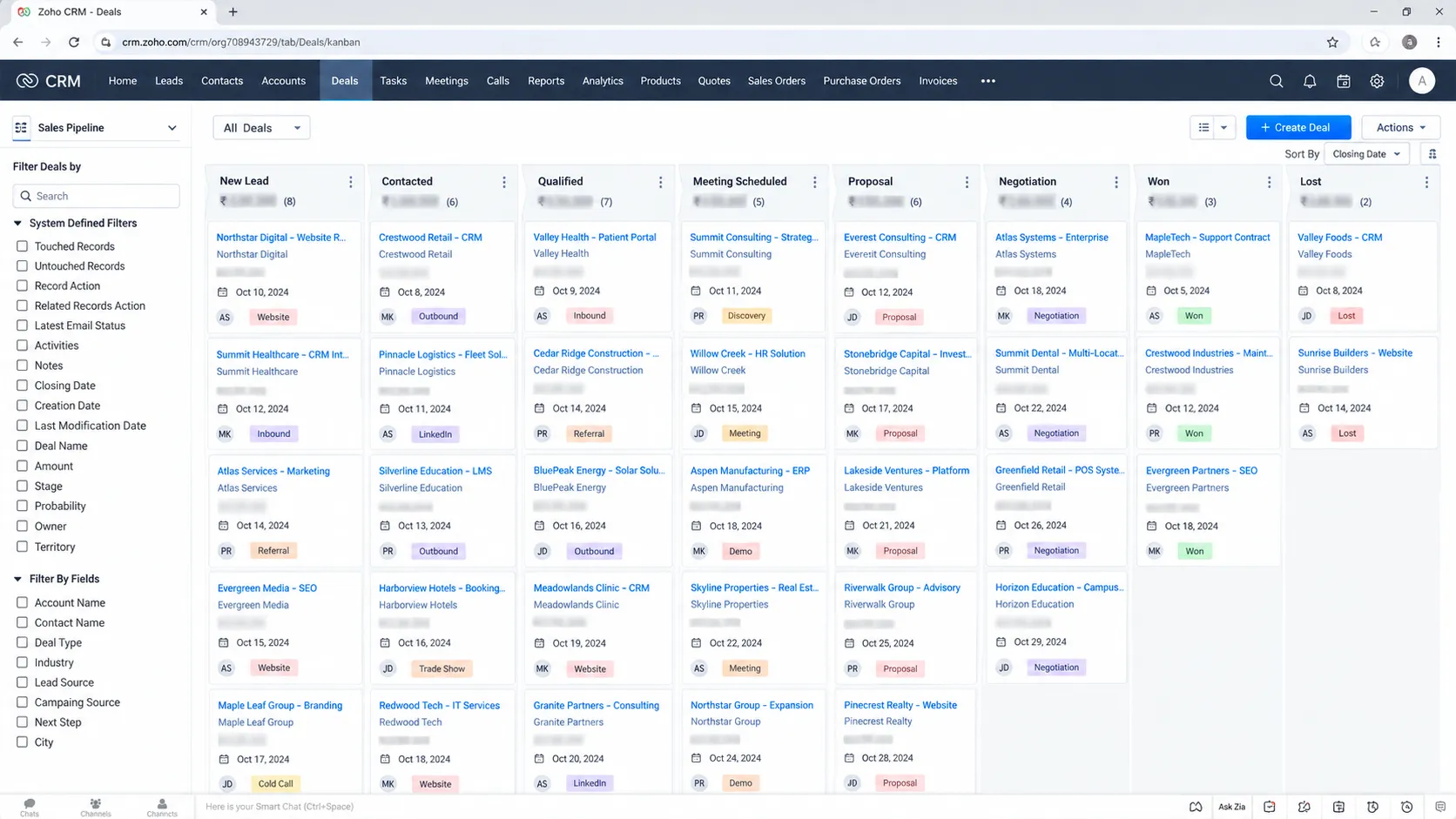
aibrevo implements Zoho CRM and wires it into the wider Zoho suite: modules, blueprint automation, workflow rules, and connections to Zoho Books, Desk, Campaigns and third-party tools — so you get one system instead of eight disconnected apps. Zoho projects typically run 3–10 weeks.
Who this is for
Budget-conscious SMBs that chose Zoho for value and want it set up so the suite actually works together.
What we implement in Zoho CRM
Modules & layouts
Standard and custom modules, layouts and validation rules for your process, so a record can't be saved half-complete and quietly become a reporting problem later.
Blueprint & automation
Blueprint stage enforcement, workflow rules and scheduled functions — Blueprint in particular can require fields, approvals or attachments before a record advances, which is stricter enforcement than a workflow rule alone.
Suite integration
Zoho Books, Desk, Campaigns, Analytics and Flow connected into one workflow, with a clear decision on whether CRM-only or Zoho One licensing fits your actual usage across apps.
Migration
Import, field mapping and de-duplication from spreadsheets or another CRM, validated before go-live rather than assumed clean.
Third-party integrations
API and Zoho Flow connections to tools outside the Zoho ecosystem, with error handling built into custom Deluge functions rather than failing silently when a field is renamed.
Reporting
Dashboards and Zoho Analytics reports for pipeline and revenue, built once the underlying modules and Blueprint stages are stable enough that the numbers won't shift under the report.
User roles & data sharing rules
Role hierarchy and data-sharing rules configured to your actual reporting structure, so managers see their team's pipeline without every rep seeing the whole company's deals by default.
Multi-currency & territory management
Currency and territory configuration for teams selling across regions, so exchange-rate handling and territory-based assignment work correctly instead of being bolted on with custom fields after the fact.
Canvas, Zia and sales-signal configuration
Canvas layouts that put the fields reps actually need on one screen, Zia AI suggestions and Zoho's sales-signals notifications tuned so alerts reflect real buying activity rather than noise, since an over-eager notification setup teaches reps to ignore every alert.
Zoho Desk, Books and Campaigns data flow
Deliberate sync decisions between CRM and the rest of the suite: which app owns the customer record, whether invoices post back to the deal, and how support tickets surface on the account so a rep sees an unhappy customer before calling to upsell them.
Email, telephony and calendar setup
Mailbox sync, click-to-call telephony and calendar connections configured per user, with shared-inbox and BCC-dropbox behavior decided up front so email history attaches to the right records instead of scattering across personal inboxes.
A typical Zoho CRM project timeline
Phase proportions are typical, not a guarantee — actual timing depends on data volume, integration count and how much of the data model is custom.
- Weeks 1–2
- Discovery, including the decision that shapes the rest of the project: standalone CRM licensing versus Zoho One, based on how many other Zoho apps genuinely need to connect. Module and Blueprint design starts here too.
- Weeks 3–6
- The bulk of a typical 3–10 week project — module, layout and Blueprint build, workflow rules, custom Deluge functions where logic exceeds what Blueprint can express, running alongside data mapping and de-duplication for migration.
- Weeks 7–8
- Suite integration (Books, Desk, Campaigns, Analytics) if in scope, third-party API connections via Zoho Flow, and validation of the migrated data against the source system.
- Weeks 9–10
- User training, a staged go-live, and a short validation window confirming Blueprint enforcement and automations behave correctly under real usage rather than just test records. Simpler CRM-only projects land at the shorter end of this range.
Common Zoho CRM projects
- Zoho CRM implementation for a growing SMB
- Zoho suite integration (CRM + Books + Desk + Campaigns)
- Migration to Zoho CRM from a spreadsheet or legacy tool
- Blueprint automation for a defined sales process
- Zoho CRM and third-party integration via Zoho Flow
Where Zoho CRM projects go wrong
Turning on every Zoho app at once
Businesses activate the whole suite in week one — CRM, Books, Desk, Campaigns, Social — before any one of them is configured properly, and nothing ends up fully working. Sequencing matters more than enthusiasm here.
Blueprint built as a suggestion, not a requirement
Stage transitions get left optional so reps skip steps under deadline pressure, and the pipeline data ends up as unreliable as the spreadsheet it replaced. Blueprint's whole value is enforcement — an optional Blueprint is just a workflow rule with extra steps.
Deluge scripts with no error handling
Custom functions written to patch a gap between modules fail silently when a field is renamed or an API limit is hit, and nobody notices until a report comes back wrong — sometimes weeks after the underlying data started drifting.
Underestimating the CRM-to-Zoho-One licensing jump
Teams license standalone CRM for a sales team, then discover that connecting cleanly to Books or Desk really wants Zoho One's suite-wide, per-employee licensing — a much bigger bill than expected if it wasn't planned for at the scoping stage.
Hitting storage, API or automation ceilings mid-year
Lower Zoho tiers cap storage, daily API calls and workflow-automation runs fairly tightly, and a CRM that starts light on data can hit those ceilings within a year of real use — forcing a reactive tier upgrade instead of a planned one.
Picking a tier based on the feature list instead of the process
A team buys the cheapest tier that lists 'workflows' and only later learns that Blueprint, custom functions or multi-pipeline support live one tier up, so the process they scoped can't actually be built on the plan they bought. Mapping required capabilities to tiers before purchase avoids paying twice.
Leaving lead and deal duplicates unchecked at the source
Web forms, imports and integrations all create records, and without duplicate-check rules and matching criteria configured up front, the same prospect appears three times with three different owners. Cleaning that up after the fact is far more work than enabling matching rules on day one.
Building integrations that depend on a single user's credentials
A Zoho Flow or API connection authenticated as one employee's account stops working the day that person leaves or resets a password. Integrations should run under a dedicated service user with documented ownership, so a staffing change never silently breaks a sync.
What does Zoho CRM implementation cost?
Zoho CRM's 2026 per-user pricing on annual billing runs about $14 on Standard, $23 on Professional, $40 on Enterprise and $52 on Ultimate, with a free edition for up to 3 users (per 2026 pricing guides). Zoho One, the suite bundle, is listed at about $37 per employee per month on the All Employee plan or about $90 per active user per month on the Flexible plan, and the choice between standalone CRM and the suite is often worth more than any single configuration decision. Partner implementation fees sit on top: industry ranges run roughly $2k for a basic setup to $50k for a large, heavily customized rollout. We quote per project after a 30-minute call.
Certified across the platforms we implement
- salesforceCertified engineers
- HubSpotCertified engineers
- Dynamics 365Certified engineers
- ZohoCertified engineers
- PipedriveCertified engineers
- monday.comCertified engineers
- AirtableCertified engineers
- GoHighLevelCertified engineers
Our engineers hold certifications on all eight platforms we deliver. We work as an independent implementation firm — no reselling, no white-label, no offshore hand-off.More about the team →
Certifications, and what they actually mean
Zoho doesn't run as extensive a public certification program as Salesforce or Microsoft, so "certified Zoho partner" status is more about Zoho's own partner-tier agreements than an individual consultant's demonstrated skill on a proctored exam. That makes project history and Deluge-scripting samples a more reliable signal than a certification badge alone when evaluating who actually builds your Zoho setup. What matters in practice is whether the person or firm has built Blueprint automations with real enforcement (not just optional workflow rules), written Deluge functions with proper error handling, and navigated the standalone-CRM-versus-Zoho-One licensing decision correctly for a business your size — ask for examples of exactly that rather than a certification list. Zoho does offer its own training and partner-tier structure, and those are worth checking, but treat them as evidence of a working relationship with Zoho rather than proof that a specific consultant can write Deluge that survives a renamed field. A practical test is to ask how they would structure a Blueprint for your sales process, which fields would be mandatory at which transition, and how they would log and alert on a failed custom function. Someone who has built these before answers in specifics; someone reciting features answers in generalities.
How to tell if your Zoho CRM setup needs a rebuild vs. a fix
A Zoho account that feels chaotic doesn't necessarily need to be rebuilt from scratch. These signals separate a quick fix from a real rebuild.
Signal it's a fix: one Deluge function throws an error
A single custom function failing under a specific condition — a renamed field, an API limit — is usually a contained bug fix, not evidence the whole automation layer is broken.
Signal it's a rebuild: everything lives in one giant module with no structure
If unrelated data has been crammed into a single module with dozens of custom fields standing in for what should be separate modules, no workflow tweak fixes the underlying reporting problems — the module structure itself needs redesigning.
Signal it's a fix: Blueprint is skipping a stage occasionally
An isolated Blueprint transition issue is usually a configuration fix to that specific stage's requirements, not a sign the automation model is fundamentally wrong.
Signal it's a rebuild: Blueprint was built as optional and reps route around it
If stage transitions were left non-mandatory and the pipeline data is now as unreliable as the spreadsheet Zoho replaced, that's a Blueprint redesign — enforcement has to be rebuilt in, not patched on top of an already-ignored process.
Signal it's a fix: a report or dashboard shows a stale number
A single outdated report is usually a filter or date-range fix, quick to resolve without touching the wider setup.
Signal it's a rebuild: the licensing tier doesn't match actual suite usage
If the business is on standalone CRM licensing but genuinely needs Books, Desk and Campaigns to talk to each other constantly, that's a Zoho One migration and integration rebuild, not a settings change.
Signal it's a fix: an integration stopped syncing after a password change
A connection authenticated under one user's credentials breaking after a reset is a re-authorization fix, ideally followed by moving it to a dedicated service account so it doesn't recur.
Signal it's a rebuild: the same customer exists as duplicate records across modules
If leads, contacts and accounts are heavily duplicated and no matching rules exist, the cleanup involves merging records, defining match criteria and rethinking how web forms and imports create records, which is a data-quality project rather than a single tweak.
How Zoho CRM compares
Zoho CRM implementation — FAQs
Can you connect Zoho CRM to the rest of the Zoho suite?
Yes — that's usually the point. We connect Books, Desk, Campaigns, Analytics and Flow so the tools share data instead of duplicating it.
Is Zoho powerful enough for our team?
For most SMBs, yes — especially with Blueprint and custom functions. The audit will tell you if you'd be better on a heavier platform.
Do you migrate historical data?
Yes, with field mapping, de-duplication and a validation pass before go-live.
Can Blueprint actually stop reps from skipping steps?
Yes — Blueprint can require fields, approvals or attachments before a record moves to the next stage, which is stricter enforcement than a workflow rule alone.
Do you write custom Deluge functions?
Yes, for logic Blueprint and workflow rules can't express — cross-module calculations, custom validations, or calling an external API from inside Zoho.
What does a typical Zoho project look like week by week?
The first week or two covers discovery and deciding standalone CRM versus Zoho One licensing; the middle stretch (the bulk of a 3–10 week project) covers module, Blueprint and workflow build alongside migration; the final week or two is suite integration, validation and a staged go-live.
How does aibrevo scope a Zoho project differently than a generic quote?
We scope from how many other Zoho apps need to connect and how much Blueprint or custom Deluge logic your process actually requires — those two factors move a Zoho project's cost more than user count, so a flat per-seat quote usually misses the real driver.
What's included in post-launch support?
30 days of monitoring after go-live, including watching Blueprint enforcement and custom functions under real usage, plus answering admin questions as your team takes over. Retained support beyond that is priced separately.
How does Zoho CRM integrate with third-party tools outside the Zoho ecosystem?
Through Zoho Flow, direct API connections, or Zapier/Make for lighter-weight needs — commonly wired to email marketing tools, payment processors and support platforms that live outside the Zoho suite, with error handling built into any custom logic so a broken connection fails loudly instead of silently.
Will we outgrow standard Zoho CRM as we add more sales headcount?
Usually not from headcount alone — Zoho scales reasonably with users. The more common ceiling is process complexity: multi-cloud requirements, deep custom API work, or heavy Deluge logic that starts to look like a case for Salesforce or HubSpot instead, which the audit will flag honestly if it's happening.
Isn't it cheaper to just configure Zoho ourselves since it's marketed as easy to set up?
For a genuinely simple setup, yes, self-configuration can work fine. Where teams get into trouble is Blueprint automation, Deluge scripting and the Zoho One licensing decision — those have real technical depth behind Zoho's approachable interface, and mistakes there (like turning on every app at once, or Blueprint left optional) are exactly what the common-mistakes list above describes.
We tried setting up Zoho ourselves and it's a mess now — can you fix it rather than starting fresh?
Yes, this is a frequent project — auditing the existing modules, Blueprint stages and Deluge functions, then fixing or restructuring only what's actually broken rather than assuming a DIY setup means starting over.
How do you decide between Zoho and a step up to HubSpot or Salesforce for a growing SMB?
Mainly on process complexity, not headcount — if Blueprint and Deluge can express your actual sales process, Zoho's cost advantage usually wins. If you need multi-cloud architecture, deep native marketing automation, or extensive third-party ISV integrations, that points toward HubSpot or Salesforce instead, and we'll say so directly on the call.
What does Zoho Blueprint do that a workflow rule can't?
A workflow rule reacts after something changes; Blueprint controls how a record is allowed to move. It can require specific fields, approvals, attachments or a note before a deal advances, and it defines who can perform each transition. That makes it the right tool when you need the process followed, not just observed.
Can we migrate from HubSpot or Salesforce into Zoho CRM?
Yes. We map objects and fields, translate stages into Zoho pipelines and Blueprint, de-duplicate before import and validate a sample against the source. Workflows and automations don't transfer directly, so we rebuild them against Zoho's model, and we flag anything with no equivalent instead of letting it quietly disappear.
How much does Zoho CRM cost per user in 2026?
On annual billing, Zoho CRM runs about $14 per user per month on Standard, $23 on Professional, $40 on Enterprise and $52 on Ultimate, with a free edition for up to 3 users, per 2026 pricing guides. Blueprint and custom functions typically sit at the upper tiers, so tier choice should follow your process, not just the price.
Is Zoho One cheaper than buying Zoho apps separately?
Often, once you use three or more apps. Zoho One was listed in 2026 at about $37 per employee per month on the All Employee plan, or about $90 per active user on the Flexible plan. The math depends on how many employees actually need access, so we model both options against your headcount before recommending one.
Can Zoho CRM handle multiple pipelines and a longer sales cycle?
Yes, on the tiers that support multiple layouts and pipelines, typically Professional and above. A longer cycle usually needs custom stage fields, Blueprint transitions with required data at each step and forecast categories your finance team recognizes. We map the real cycle first, then check it against the tier's limits.
What are Zoho's API and storage limits, and do they matter for us?
Zoho ties daily API calls, storage and workflow-automation runs to the plan and user count, and lower tiers are tighter. They matter most for integration-heavy or attachment-heavy teams. We estimate expected volume during scoping so the tier you buy has headroom for the first year rather than forcing a mid-year upgrade.
Other platforms we implement
Scope your Zoho CRM project
A 30-minute call with an engineer. You leave with a written read on your current setup and a clear recommendation — whether or not you hire us.
Book a 30-min call