
 By Alpit Patel and the aibrevo team · September 16, 2026 · Updated September 17, 2026 · 17 min read
GoHighLevel for Med Spas: A Practical Automation Guide
How med spas use GoHighLevel to speed up lead response, automate consultation and reminder sequences, recover no-shows, renew memberships, and generate reviews, sized against AmSpa and Boulevard's 2024-2026 industry benchmark data.
Key takeaways
- AmSpa's 2024 State of the Industry report found repeat-patient rate climbing from 65% to 73% between 2022 and 2024 — on an average $527 spend per visit, moving a typical spa's own retention toward that top end is worth real, calculable revenue, not just a satisfaction metric.
- No-show recovery works best as a short, specific sequence tied to the exact appointment that was missed, not a generic reminder resent on a delay — and there's no credible, named-methodology figure for med-spa-specific no-show rates worth citing as fact.
- Membership and package renewal automation needs a trigger tied to package unit count or membership renewal date, not a flat calendar reminder every client gets on the same schedule, which matters given PatientNow's finding that membership programs can represent 20-30% of a spa's revenue.
- Treatment-based segmentation, tagging a contact by the specific service they inquired about, lets a med spa follow up on genuinely related services instead of sending every lead the same generic newsletter.
- Boulevard's 2026 data puts average med spa revenue near $1.8-2M with 20-25% profit margins (30-40% for top performers) — a scale where a few points of retention or a handful of recovered no-shows move real dollars, not rounding error.
- None of this replaces a compliant, verified consent and intake process. Automation handles scheduling and communication, not medical recordkeeping, and cash-pay aesthetics sits in a genuinely different HIPAA posture than clinical medicine.
Med spas lose more revenue to slow lead response and unmanaged no-shows than to weak marketing. A new injectable or laser inquiry that sits unanswered for even a few hours is often already being answered by a competing practice down the street, and a missed appointment that never gets a rebooking follow-up is a fully lost slot, not just a scheduling inconvenience. Two dated, named-methodology industry reports — AmSpa’s 2024 State of the Industry survey and Boulevard’s 2026 benchmark data — put real numbers on what that revenue is worth at a typical spa’s scale. GoHighLevel handles lead response and no-show recovery, along with membership renewals, review generation, and follow-up on related services, inside one CRM rather than a patchwork of a booking tool, a texting app and a spreadsheet. This guide covers how a med spa actually configures each piece.
If you’re deciding whether to build this in-house or bring in outside help, the GoHighLevel implementation services page covers what a scoped project includes for an aesthetics practice.
What the numbers actually say about a typical med spa
Most “med spa statistics” pages circulating in search results cite figures with no traceable source: a specific no-show percentage, a customer-lifetime-value dollar figure, a membership-retention lift multiplier, all repeated from one vendor blog to the next with no named survey or sample behind them. Two reports are worth building on instead, because both disclose their methodology.
AmSpa’s 2024 Medical Spa State of the Industry report is the most-cited, best-sourced figure in the category:
Boulevard’s 2026 data picks up where AmSpa’s 2024 figures leave off, and shows the same industry still growing:
Put AmSpa’s retention shift in dollar terms for a spa running near its reported average: at 245 monthly visits and $527 average spend, that’s roughly $1.29M in annual visit revenue. Moving repeat-patient rate from a 65%-era baseline toward the 73% reported in 2024 doesn’t translate one-to-one into revenue — repeat visits and new-patient visits aren’t priced identically, and this is an illustrative calculation, not a guaranteed outcome — but an 8-point swing in what share of visits come from returning clients, at that scale, is a six-figure-adjacent number for a spa near AmSpa’s reported average, not a rounding error. That’s the specific number membership renewal, package-expiration and treatment-relevant follow-up automation are built to move.
For sizing the category itself: IBISWorld’s August 2026 estimate puts the U.S. “Health & Wellness Spas” industry at $24.1B, growing at a conservative 2.4% annual rate. That figure is worth naming specifically as the domestic, conservative estimate — larger global market-research projections use broader category definitions and different growth assumptions, and the two shouldn’t be quoted interchangeably.
One category of stat is worth flagging rather than repeating: med-spa-specific no-show rates (commonly cited as 15-25% or 17-22%), “94% of patients read reviews,” specific lifetime-value dollar figures, and membership-retention lift multipliers (a jump from 54% to 78%, or “2.9x more visits”) all trace back to vendor blog content with no disclosed methodology or sample. The MGMA’s August 2025 no-show polling is real and worth citing directionally, but it covers general medical practices, not med spas specifically — treat it as a broad healthcare-scheduling signal, not a med-spa benchmark.
Instant lead response
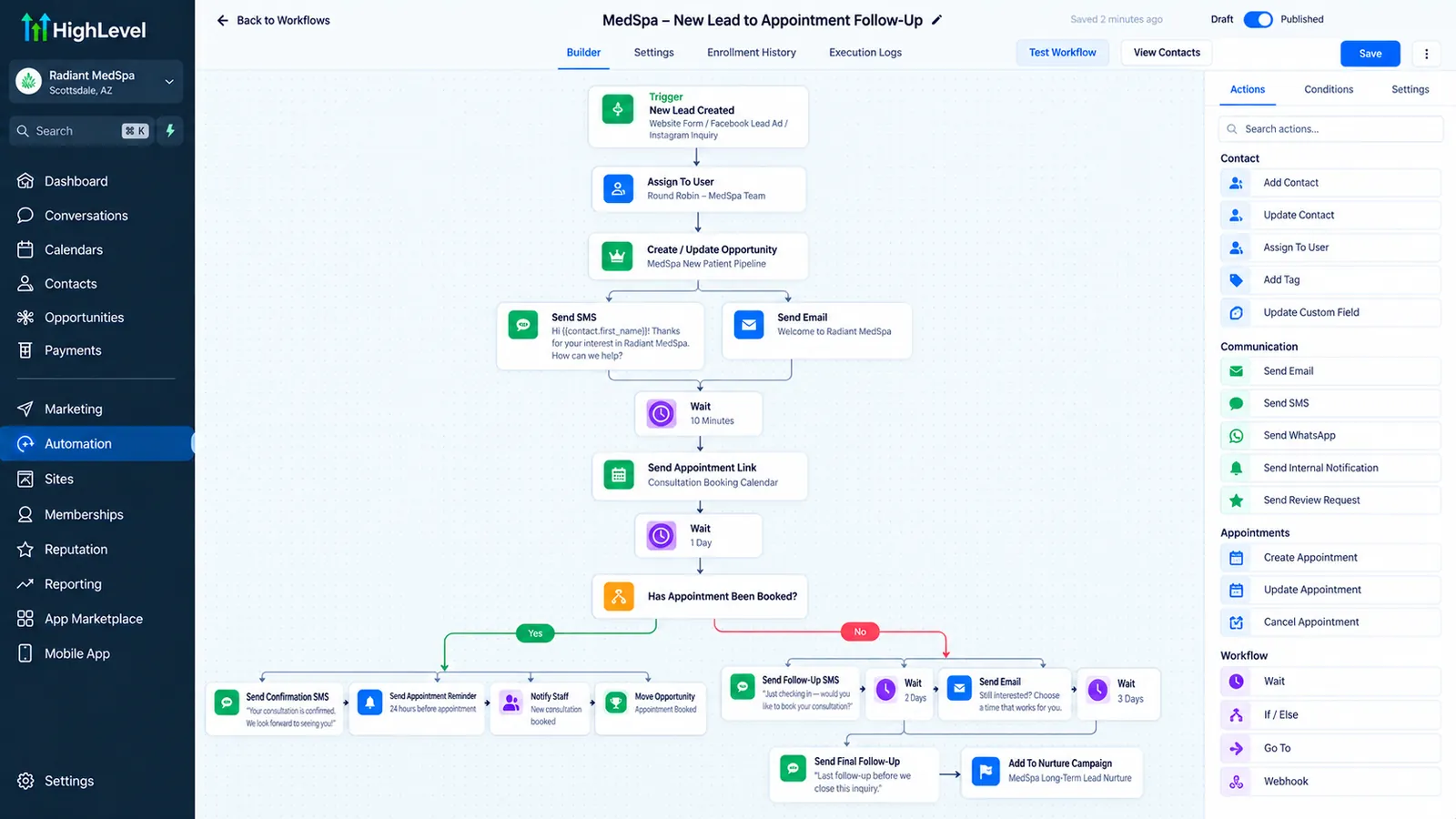
A missed call or form submission triggers an immediate text confirming receipt and offering the next available consultation slot, closing the gap before a competing practice replies first.
Captures the inquiry while it's still comparison shoppingConsultation booking and reminders
A booking link inside the same conversation lets the lead pick a slot directly, then a staged reminder sequence, confirmation, day-before, and same-day, keeps the appointment on the calendar.
Turns a reply into a booked visit without a manual back-and-forthNo-show-to-rebook SMS
A no-show tag applied automatically in the calendar triggers a same-day, judgment-free rebooking message, followed by one or two more touches if the client hasn't responded, exiting the moment they rebook.
Recovers the slot before the client moves onMembership renewal countdown
A custom field tracking renewal date counts down and triggers a staged reminder sequence as the date approaches, rather than a flat calendar blast sent to every client on the same day regardless of where they actually are in their cycle.
Lands the reminder at the right moment, not a generic onePackage-session upsell trigger
A custom field tracking remaining package units fires an offer when a client nears the end of a course of treatments, prompting renewal or upgrade before the package simply runs out.
Converts a natural checkpoint into a renewal conversationMissed-call-to-text
An unanswered inbound call triggers an immediate text acknowledging the miss and offering to continue by text, so the inquiry doesn't move to the next practice's number.
Recovers calls that would otherwise go to voicemailTreatment-based segmentation
A tag applied when a lead inquires about or books a specific service, injectables, laser, skincare, determines which nurture content and related-service suggestions that contact receives going forward.
Keeps follow-up relevant instead of one generic newsletterSpeed matters more than script quality for new inquiries
A med spa’s highest-value automation is the one that answers a lead before a competitor does. Someone searching for Botox, filler, or laser hair removal nearby is frequently messaging or calling more than one practice in the same sitting, comparing availability and starting price before booking a consultation anywhere. The practice that responds first with a real, specific answer wins a meaningful share of those inquiries regardless of how polished its brochure site is.
GoHighLevel’s missed-call text-back feature handles the phone side of this automatically: if a call to the practice goes unanswered, the system immediately sends a text acknowledging the missed call and offering to help by text instead. For web and form-based inquiries, a workflow triggered on form submission can fire an instant reply confirming receipt and prompting the lead toward booking a consultation, rather than leaving them to wonder whether the form actually went anywhere. Neither of these requires a staff member to be watching a dashboard in real time, which matters for a practice where front-desk staff are frequently occupied with clients already in the building.
The reply itself should do more than acknowledge the message. A short, specific response, confirming interest, offering the next available consultation slot, and including a direct booking link, moves a lead toward an actual appointment far more effectively than a vague “thanks, we’ll be in touch.”
Automate consultation booking and reminder sequences
Once a lead responds, the booking step should happen inside the same conversation rather than routing them to a separate scheduling tool. GoHighLevel’s calendar and booking widget let a lead pick a consultation slot directly from a text or email link, which creates the appointment and the contact record in one motion instead of a manual back-and-forth over available times.
After booking, a reminder sequence keeps the appointment from becoming a no-show. A typical sequence sends a confirmation immediately after booking, a reminder a day or two before the appointment, and a same-day reminder a few hours ahead. Each message should reflect the specific appointment, service, date, time, location, using merge fields pulled directly from the calendar record so the sequence works correctly across every service type and provider without hand-editing a template for each one.
The consultation-to-treatment gap is also worth automating separately. A client who completes a consultation but hasn’t booked their actual treatment within a set window (say, a week) is a warm lead who needs one more nudge, not a cold lead who needs to be re-marketed to from scratch. A short follow-up workflow addressing common hesitations, financing questions, timing concerns, closes more of these than leaving it to a front-desk callback list that may or may not get worked consistently.
Build a no-show-to-rebook sequence tied to the missed appointment
A missed appointment is a fully empty slot that generated no revenue and likely displaced another client who could have taken it. Recovering that client matters, but the recovery message needs to be specific to what happened, not a generic reminder resent after the fact.
The workflow starts with a tag applied automatically when an appointment is marked as a no-show in the calendar. That tag triggers a short sequence: a same-day text acknowledging the missed appointment without blame, offering an easy way to rebook, followed by one or two additional touches over the following days if the client hasn’t responded. The sequence needs an explicit exit condition, the client rebooks, so it stops the moment the actual problem is solved rather than continuing to message someone who already handled it.
Some practices layer a policy reminder into this sequence (deposit requirements, cancellation windows) if repeated no-shows are a recurring issue with a specific client. That’s a business-policy decision each practice needs to make on its own, but the automation itself, tag on no-show, trigger a specific recovery sequence, exit on rebooking, is the same structural pattern regardless of what policy sits behind it.
Automate membership renewal countdowns and package-session upsells
Med spas running membership programs or prepaid treatment packages have a renewal problem a flat calendar reminder doesn’t solve well. Clients start memberships on different dates and use package units at different rates, so a single renewal campaign sent to the whole list on the same day either reaches people too early, too late, or not at all relative to their actual situation — and PatientNow’s 2025 analysis found membership programs can represent 20-30% of a med spa’s total revenue, with retail sales another 10-15%, which is a large enough share to justify building the trigger logic properly.
The more reliable setup ties the renewal trigger to the client’s own data: a custom field tracking membership renewal date, or a package field tracking remaining treatment units. A workflow checks that field and fires a renewal countdown a set number of days before the actual renewal date, or when remaining units drop to a defined threshold (for example, one treatment left in a six-pack laser package) to trigger a package-session upsell offer. This requires more setup than a single blast campaign, building the custom fields, populating them accurately as treatments are used or memberships bill, and configuring the trigger logic, but it’s the difference between a renewal reminder that lands at the right moment and one that reads as a mistimed generic promotion.
Package expiration follow-up deserves its own smaller workflow. A client with an unused, soon-to-expire package unit is a strong candidate for a quick “you still have a session available” reminder, since letting that unit expire unused is a poor outcome for both the client and the practice’s retention numbers.
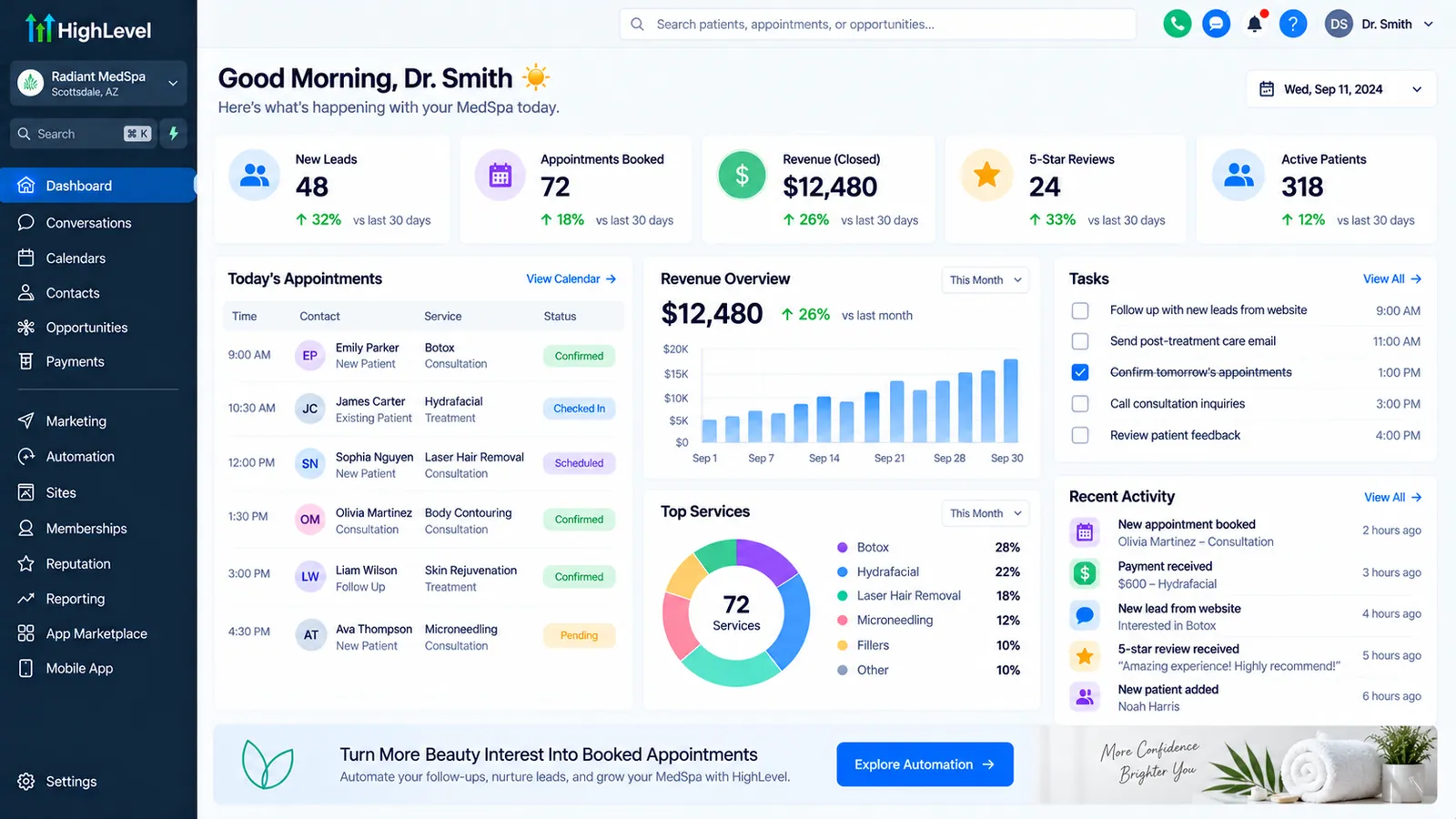 *Illustrative example of a GoHighLevel pipeline view for a fictional med spa practice, built to show how appointment and membership stages might be organized. Names and figures shown are invented sample data, not an actual client's account.*
Segment by treatment interest so follow-up stays relevant
A client who asks about Botox and a client who asks about laser hair removal have different concerns, different price sensitivity, and different services worth mentioning in follow-up. Treating both leads identically in one generic newsletter list wastes the segmentation GoHighLevel is actually built to support.
The setup starts with tagging. When a lead inquires about or books a specific service, injectables, laser, skincare, body contouring, a tag records that interest on the contact record. That tag then determines which nurture content, promotions, and related-service suggestions the contact receives going forward. A client tagged for injectables might later receive information about a complementary skincare service that pairs well with their existing treatment, while a client tagged for laser hair removal sees content relevant to that treatment’s typical course length and touch-up schedule, rather than both getting the exact same monthly email.
This segmentation also improves review requests and renewal messaging, since a message referencing the client’s actual treatment history reads as attentive rather than generic. Getting the tag structure right during setup, deciding which service categories matter enough to warrant their own tag and workflow branch, is worth doing deliberately rather than tagging ad hoc after workflows are already built around a flat contact list.
A practical starting point is limiting the initial tag set to the service lines that actually drive volume, injectables, laser, and skincare are a common baseline, then adding a body-contouring or wellness tag only once that service line has enough contacts to justify a dedicated workflow branch. Building ten narrow tags before any of them has real volume behind it tends to create maintenance overhead without a matching payoff, since each tag needs its own nurture content kept current.
Automate review generation around the right moment
Timing matters more than wording for review requests. A request sent immediately after a positive outcome, a satisfying consultation, a completed treatment package, a follow-up visit showing good results, converts at a meaningfully higher rate than one sent on a fixed delay regardless of how the appointment actually went.
A straightforward setup triggers a review request text or email a day or two after an appointment is marked complete, with a direct link to the practice’s preferred review platform. Some practices add a private feedback step first, a quick “how did we do” message that routes a dissatisfied response to internal follow-up instead of a public review platform, while a positive response proceeds to the public review ask. This pattern needs to apply the same way to everyone rather than selectively skipping clients believed to be unhappy, since selectively soliciting only satisfied clients can run against some review platforms’ policies on review solicitation.
Building this as its own workflow, separate from the appointment reminder sequence, keeps the timing and messaging clean and makes it easy to adjust the trigger delay or wording later without touching the reminder logic.
How do you know the automation is actually working?
Track five numbers from your own account, not industry averages, because the whole point of building these workflows is to move your spa’s specific baseline. Pull a snapshot of each before you launch anything, so there’s a real before-and-after rather than a vague sense that things feel busier.
- Speed to first response. The time between an inquiry arriving (form, call, or message) and the first reply. Missed-call text-back and instant form replies should push this from hours to seconds; if it doesn’t, a workflow isn’t firing.
- Inquiry-to-consultation rate. Of the leads that come in, how many book a consultation. This is the number the first-response workflow and the booking link inside the conversation exist to move.
- Consultation-to-treatment rate. Of completed consultations, how many book the actual treatment. The follow-up workflow for the consultation-to-treatment gap targets this one, and it’s often the largest recoverable leak.
- No-show and rebook rate. How many appointments end as no-shows, and of those, how many rebook within a set window such as seven days. The second number is the direct measure of the recovery sequence.
- Renewal rate on memberships and packages. Renewals as a share of memberships reaching their renewal date, tracked from the custom field the countdown workflow reads.
The dollar math is worth doing once, using the AmSpa averages above and labeled as illustrative rather than a projection for your spa. At $527 average spend per visit, every no-show that rebooks and attends is worth roughly that amount. A spa recovering just four slots a month is looking at about $2,100 a month, or a little over $25,000 a year, from a workflow that runs without anyone touching it. Swap in your own average ticket, since a spa selling mostly $150 skincare visits and one selling $800 injectable sessions will land far apart.
Two checks catch silent workflow failures. First, tag counts: if the “no-show” tag is being applied to only a handful of contacts a month while your calendar shows more missed appointments than that, staff aren’t marking no-shows consistently and the recovery sequence never triggers. Second, exit conditions: sample a few contacts who rebooked and confirm they stopped receiving recovery messages, because a sequence that keeps texting someone who already booked does more damage to trust than a missed follow-up would have.
A sensible rollout order, for a spa building this from scratch, is lead response and booking first (fastest payback, simplest to test), then reminders and no-show recovery, then review requests, and only then the more data-dependent pieces: membership renewal countdowns and treatment-based segmentation. Those last two depend on custom fields being populated accurately, which usually means someone at the front desk changing how they record packages and memberships, so they take longer to become reliable than the first three no matter how quickly the workflows themselves get built.
HIPAA and cash-pay aesthetics: a genuinely different posture
Med spa compliance gets discussed as if it were identical to clinical medicine, and it usually isn’t. GoHighLevel offers a HIPAA-compliant tier with a signed Business Associate Agreement for practices that need it, but cash-pay aesthetics sits in real regulatory grey area that a clinical practice doesn’t: much of what a med spa actually sends — appointment scheduling, membership status, general promotions, treatment-interest nurture content — may not constitute protected health information at all, depending on how it’s worded and what it references. That’s genuinely different from a dental or medical practice, where nearly every patient communication touches diagnosis or treatment history and therefore needs to be treated as PHI by default.
That doesn’t mean a med spa can assume nothing it sends needs protection — a message referencing a specific injectable treatment, a documented reaction, or medical history crosses into PHI territory the same way it would anywhere else. Whether your specific communications require the HIPAA tier is a fact-specific compliance determination, and it belongs with your practice’s own legal or compliance advisor, not a general implementation guide.
What a med spa automation build actually requires
Most of what’s covered here fits inside a standard GoHighLevel single-business setup, adapted specifically to a med spa’s service menu and appointment types rather than left as a generic snapshot. The core pieces are the calendar and booking configuration, the reminder and no-show workflows, the membership and package custom fields with their renewal triggers, the treatment-interest tagging structure, and the review-request workflow, each built and tested against the practice’s actual services rather than assumed to work out of the box from a template built for a different kind of business.
None of this replaces a compliant intake and consent process. Automation handles scheduling, reminders, and marketing communication; medical intake forms, consent documentation, and any HIPAA-sensitive communication should be scoped separately with attention to what tier of GoHighLevel (or which additional safeguards) your specific data flow actually requires, confirmed with your own compliance advisor rather than assumed from a general guide.
The bottom line for med spas using GoHighLevel
Med spas that get real value out of GoHighLevel treat lead response speed, no-show recovery, and treatment-based segmentation as the priority builds, not an afterthought layered onto a generic marketing snapshot. Fast, specific replies to injectable and laser inquiries capture leads that would otherwise book with a faster-responding competitor. No-show-to-rebook automation and membership renewal countdowns tied to real appointment and package data recover revenue a flat, one-size-fits-all reminder schedule misses, at a scale where AmSpa and Boulevard’s numbers show a few points of retention are worth real money. A practice weighing whether to build this internally or bring in outside help can start with the GoHighLevel implementation services page for a breakdown of what a properly scoped setup involves.
To have these workflows built and tested for you, see GoHighLevel setup for med spas, which covers deliverables, booking-software connections, HIPAA activation and cost.