
 By Alpit Patel and the aibrevo team · September 16, 2026 · Updated September 18, 2026 · 15 min read
GoHighLevel Automation ROI in 2026: What Actually Moves the Number
A practical framework for estimating real ROI from GoHighLevel automation, where the returns are genuine versus overstated, and a full map of aibrevo's GoHighLevel guides.
Key takeaways
- The most reliably measurable ROI driver in a GoHighLevel build is speed-to-lead: faster response time has a direct, trackable relationship to lead-to-opportunity conversion rate, and that conversion delta is the cleanest number to model before investing in a build.
- The most commonly overstated ROI claim in GoHighLevel marketing is a flat multiplier ('3x your revenue') applied without reference to a specific business's actual lead volume, close rate, or deal value. A framework beats a borrowed number every time.
- The real cost automation replaces isn't a salary line, it's the compounding cost of leads and follow-ups that silently fall through manual gaps. That number is usually invisible until someone actually audits how many leads went untouched in a given month.
- Automation ROI is front-loaded in acquisition (speed-to-lead, nurture, routing) and back-loaded in retention (churn flagging, reactivation, expansion). A build that only covers the front half systematically underestimates its own long-term return.
- Implementation cost is a fixed, mostly one-time number ($500-$12,000 depending on scope, per aibrevo's published GoHighLevel pricing); the return compounds over every month the automation keeps running, which is why the relevant comparison is cost against a full year of impact, not against the first month.
- A business that hasn't fixed foundational setup issues (workflows not triggering, broken calendar sync, email deliverability problems) will see automation ROI numbers that look artificially low, because the automation isn't actually running correctly, not because the underlying strategy is wrong.
“Is GoHighLevel automation actually worth it?” is really two questions wearing one sentence. The first is whether automation, in general, is worth it for a business like this. The second, separate question is whether this specific build, at this specific cost, is going to pay for itself. The first question has a fairly durable answer. The second one depends entirely on numbers that are different for every business, which is exactly why a borrowed ROI multiplier from someone else’s marketing is worth less than a framework applied to your own.
The most-quoted CRM ROI stat has already been retired by the firm that published it
Most content about CRM or automation ROI, including a lot of GoHighLevel marketing, still leans on one number: “CRM returns $8.71 for every dollar spent.” That figure came from Nucleus Research, a firm that has tracked CRM returns for well over a decade, and it was accurate when it was published in June 2014. It’s also twelve years old, and the same firm has since told the industry, in writing, that the number no longer holds.
In August 2023, Nucleus Research re-examined 63 CRM ROI case studies and published a follow-up: real CRM ROI had fallen 37% over the prior decade, from $4.90 down to $3.10 per dollar spent. Most of the industry is still quoting the 2014 report’s $8.71 figure as if it were current, when Nucleus Research’s own more recent number is barely a third of that.
The decline isn’t really a story about CRM software getting worse. It tracks with a market that matured: more businesses running similar automation, rising customer expectations for fast response, and the natural erosion of an early-adopter advantage as the tools that once separated a business from its manual-process competitors became the default across the whole category. When everyone has the same tool, the tool stops being the edge. Implementation quality and follow-through become the actual differentiator, which is the case this entire post is built around.
Two things worth saying plainly. First, almost nobody quoting “$8.71” mentions that the firm behind the number has already superseded it. Second, a 37% decline still leaves real, positive average ROI, so this isn’t an argument that CRM or GoHighLevel automation stopped paying off. It’s an argument against treating any flat multiplier, whichever number gets attached to it, as a substitute for modeling your own business’s numbers. That’s the case the rest of this post makes with a specific framework instead of another borrowed figure.
Where automation ROI is genuinely measurable
Speed-to-lead is the cleanest number in the entire category. There’s a direct, trackable relationship between how fast a new lead gets a first response and how likely that lead converts into a real opportunity. A widely cited 2011 Harvard Business Review study by Oldroyd, McElheran and Elkington analyzed roughly 2.24 million leads across 2,241 companies and found that leads contacted within an hour were about 7 times more likely to qualify than leads contacted even slightly later, and that leads contacted after 24 hours were roughly 60 times less likely to qualify at all. The full study sits behind HBR’s paywall, but these figures have been re-cited consistently enough across independent industry research in the years since that they’ve held up as a reasonable planning benchmark. The exact multiplier matters less than the underlying point: this isn’t a claim that requires trusting anyone’s marketing. It’s measurable inside a single business’s own CRM data, before and after automating the first response.
Missed-call and after-hours recovery is nearly as clean, and how often it matters varies more by industry than most businesses assume. A January 2025 CallRail benchmark report, which analyzed 1.1 million leads, found that healthcare businesses missed 32% of inbound calls, legal firms missed 28%, home services businesses missed 14%, and real estate missed 9%.
A call that goes unanswered and gets no follow-up is a lead that, in most competitive markets, simply goes to whoever answers next. An automated text-back the moment a call is missed recovers some meaningful share of leads that would otherwise be gone entirely. The honest way to estimate the size of that opportunity is tracking how many calls currently go unanswered in your own business in a typical month, not assuming a generic number. The gap between a 9% miss rate and a 32% miss rate changes the size of the recoverable pool by more than three times, and industry alone predicts a lot of that difference.
Both of these are worth baselining before a build even starts, not after. A business that can say “we currently answer new inquiries within four hours on average, and roughly 15% of our inbound calls go unanswered during business hours” has a real before-picture to compare against once automation is running. Without that baseline, the after-picture has nothing to be measured against, and the ROI conversation drifts back toward impression rather than evidence.
Follow-up consistency on proposals and quotes is a third reliable driver, for the simple reason that manual follow-up reliably degrades as volume grows. A workflow doesn’t forget to send the third follow-up message the way a busy person does.
Where ROI claims get overstated
The most common inflated claim is a flat multiplier, something like “clients see 3x their investment back,” presented without reference to a specific business’s lead volume, close rate, or average deal value. Those three inputs vary enormously between a solo chiropractor and a multi-location real estate brokerage, which means a multiplier borrowed from someone else’s business tells you almost nothing about yours.
A second overstated pattern is crediting automation for outcomes that were really driven by something else entirely: more ad spend, a stronger offer, a better sales rep, simply because the automation happened to be running at the same time. Automation amplifies whatever’s already working. It doesn’t manufacture demand or fix a genuinely weak offer, and a business that sees revenue climb after both a new ad budget and a new automation build launch in the same month should be honest with itself about which one actually did the heavier lifting.
A third pattern shows up specifically in GoHighLevel and CRM implementation marketing: agency case studies that publish a precise-sounding multiplier, something like “clients see 18x their investment back” or “30% revenue growth in 90 days,” without disclosing the case count, the timeframe, or how the number was calculated. A specific number isn’t the same thing as a verifiable one. Without the underlying methodology, there’s no way to know whether a published multiplier reflects one unusually strong client, a small handful of businesses, or a genuinely repeatable pattern across a real sample size, which is exactly why this post leans on named, dated research and a framework instead.
A framework for estimating your own number
- Baseline the current state. How many leads come in per month, and how many currently get a response within an hour, within a day, or never at all?
- Estimate the conversion lift, conservatively. What’s the realistic improvement in lead-to-opportunity conversion from consistent fast response? Use a conservative estimate you could defend, not an optimistic one you can’t.
- Multiply by average deal value. The conversion lift, applied to current lead volume and average deal value, produces an estimated monthly revenue impact specific to your business.
- Compare against implementation cost as a one-time number against a full year of impact, not against the first month. A $500-$4,000 single-business GoHighLevel build (see the implementation cost guide for the full breakdown by tier) is a very different comparison against twelve months of recovered leads than against the first thirty days.
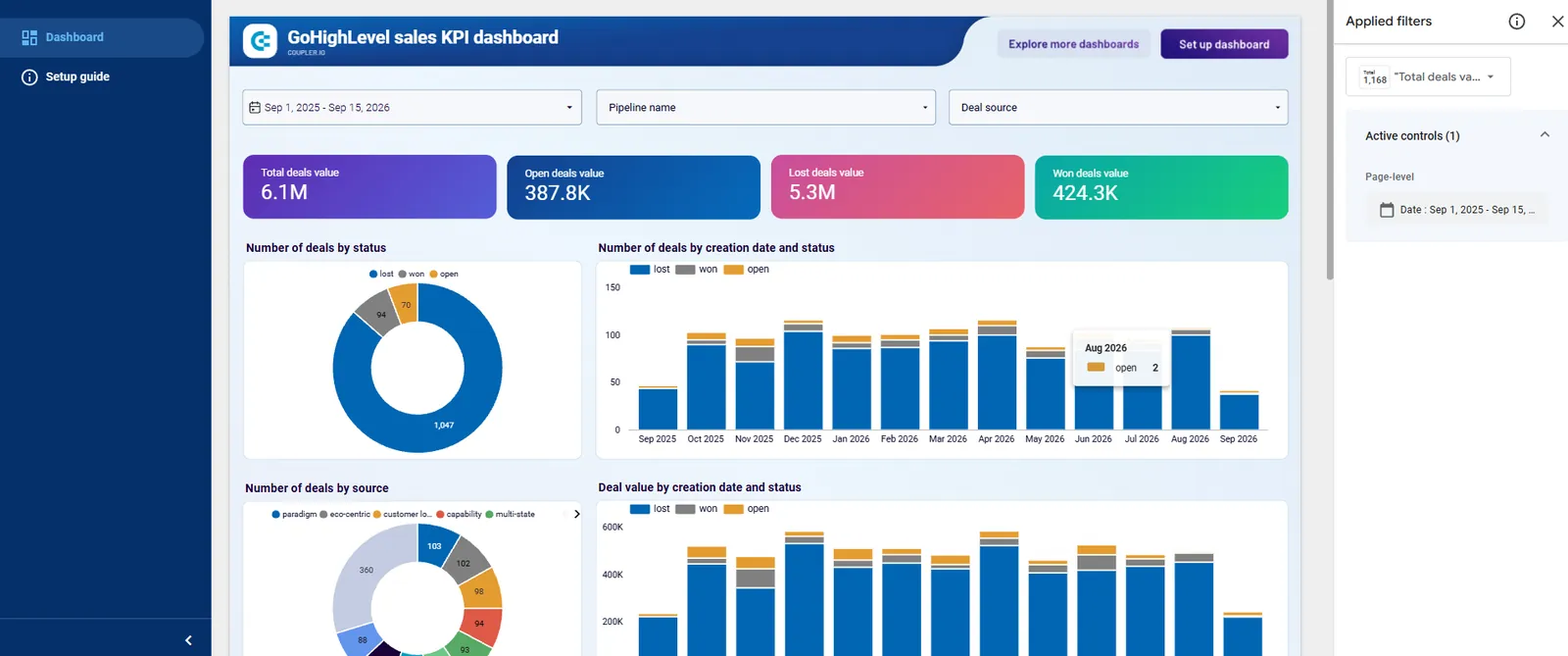 *Illustrative example of a GoHighLevel reporting dashboard showing the specific metrics worth tracking as you build your own ROI baseline: deal volume and value by status, and how both trend month over month.*
Acquisition ROI versus retention ROI
Most GoHighLevel builds get scoped around acquisition-side automation first: speed-to-lead, nurture sequences, routing. That’s a reasonable starting point, but it’s only half the available return. Retention-side automation, churn-risk flagging, reactivation campaigns for lapsed customers, expansion sequences for existing accounts, is usually cheaper to act on than acquiring a new customer from scratch, and it’s the half of the ROI equation that gets built later, or skipped, more often than it should be.
Part of why retention gets deprioritized is sequencing rather than judgment: a new build naturally starts with the front door, since there’s no point automating renewal reminders for customers a business isn’t yet reliably acquiring. The mistake isn’t building acquisition first, it’s stopping there once the front-of-funnel automation is stable and never circling back to add the retention layer on top, even after the business has enough of a customer base for reactivation and churn-flagging to start paying for themselves.
A typical breakdown of where implementation effort goes within a single-business GoHighLevel build, roughly proportional across aibrevo's $500-$4,000 tier. Multi-location and white-label builds shift more weight toward integration and testing as the number of sub-accounts and connected systems grows, and every project's actual split depends on scope.
A worked example, using illustrative numbers
The framework above is more useful with numbers attached, so here’s a worked illustration — invented figures for a fictional business, not a real client result, used only to show how the math actually runs. Picture a home-services business getting 200 inbound leads a month, currently averaging same-day response (not immediate) and closing 18% of leads into paying jobs at an average job value of $850.
Baselining: at 18% close rate on 200 leads, that’s 36 closed jobs a month, or roughly $30,600 in monthly revenue from that lead volume. Now apply a conservative conversion lift from faster, more consistent first response — say a 4-percentage-point improvement, from 18% to 22%, which is a deliberately modest assumption relative to the far larger multipliers cited in speed-to-lead research earlier in this post. That’s 8 additional closed jobs a month, worth roughly $6,800 in additional monthly revenue, or about $81,600 annualized. Against a single-business GoHighLevel implementation in the $500-$4,000 range, the payback period on just this one lever, speed-to-lead alone, lands well inside the first month, even using a conservative lift estimate and before counting missed-call recovery, proposal follow-up, or any retention-side automation at all.
The point of walking through this isn’t the specific dollar figure — a different business with different lead volume, close rate or deal value gets a different number, sometimes a much smaller one. The point is that this is a calculation any business can run with its own actual numbers in about ten minutes, and it produces something far more defensible than accepting a vendor’s flat multiplier. A business that runs this exercise and finds the payback period is 14 months instead of one month hasn’t found a reason automation doesn’t work; it’s found the actual, business-specific number worth weighing against the cost, priced honestly instead of optimistically.
Payback period vs. ROI multiple: which one should actually drive the decision?
ROI multiple (dollars returned per dollar spent) and payback period (how long until the investment breaks even) answer different questions, and conflating them is a common source of confusion in automation-cost conversations. A build with a modest ROI multiple but a short payback period is often the safer bet for a cash-constrained business than a build with a spectacular multiple but a payback period stretched over 18 months, because the shorter-payback build de-risks faster — it’s proven itself before a second contingency has time to change the business’s circumstances.
For a one-time implementation cost paired with an ongoing, low monthly platform fee (GoHighLevel’s own subscription, layered on top of the one-time build cost), payback period is usually the more decision-relevant number for a business sizing its first automation investment, and ROI multiple becomes more relevant once payback is already comfortably inside a few months and the conversation shifts to “how much value does this keep compounding after it’s paid for itself.” Both numbers come out of the same framework above — payback period is simply the point where cumulative estimated monthly impact first exceeds the one-time implementation cost.
How does business size or multi-location structure change the ROI math?
The framework holds at any scale, but which lever matters most shifts as a business gets bigger. A single-location, single-provider business (a solo chiropractor, a small home-services shop) usually gets the most ROI concentrated in speed-to-lead and missed-call recovery, because the owner or a small team is juggling sales alongside delivery work, and manual follow-up degrades fastest exactly when things get busy. A multi-location or franchise business gets a second, often larger lever: consistency across locations. A single owner-operator can be inconsistent about follow-up speed without it showing up as an aggregate business problem; a ten-location franchise with the same inconsistency multiplied across ten separate teams turns into a measurable, aggregate revenue leak that’s often larger in total dollars than any single location’s speed-to-lead gain, even if each location’s individual improvement looks modest.
This is part of why aibrevo’s own GoHighLevel implementation tiers scale the way they do — a $4,000-$12,000 multi-location build isn’t simply “the single-business build times the number of locations,” it’s pricing in the added complexity of standardizing automation across locations that previously ran inconsistent (or no) follow-up processes independently, plus the reporting layer needed to see performance across locations in one place rather than location by location. For a multi-location business modeling its own ROI, the more useful baseline question isn’t “what’s our average close rate” — it’s “how much does close rate vary location to location today,” since that variance is usually where the recoverable ROI is concentrated.
The real cost automation replaces
It’s tempting to frame automation ROI against a salary line, something like “this replaces X hours of manual work,” but the more accurate framing is the compounding cost of leads and follow-ups that silently fall through manual gaps: the lead nobody called back inside the window that actually mattered, the quote that got sent and never followed up on again, the client who quietly disengaged without anyone noticing until they’d already decided to leave. This cost is mostly invisible until someone actually audits a typical month’s worth of leads and follow-ups, which is a useful exercise before assuming ROI is speculative rather than concrete and already happening in reverse.
How does GoHighLevel’s own reporting help track ROI after launch?
Once a build is live, the baseline-and-compare exercise from the framework above only stays honest if someone actually keeps measuring it, and GoHighLevel’s native reporting gives most of what’s needed without a separate BI tool. Pipeline reporting by stage shows deal volume and value moving through the funnel over time, which is the direct comparison point against the pre-automation baseline. Call tracking and missed-call reporting shows the recovery rate on the after-hours and missed-call workflows specifically. Workflow-level reporting (how many contacts entered a given workflow, how many completed it, where they dropped off) shows whether a follow-up sequence is actually running at the volume it’s supposed to, which matters because a workflow silently failing to trigger for a subset of leads produces exactly the kind of “automation isn’t working” impression covered in the next section, when the real issue is a configuration gap rather than a strategy failure.
The practical habit worth building is a monthly or quarterly check against the original baseline numbers, not a one-time before-and-after comparison done right after launch and never revisited. Lead volume, close rate and deal value all drift over time for reasons unrelated to the automation itself — seasonality, ad spend changes, a new competitor — and re-baselining periodically keeps the ROI conversation honest instead of anchored to numbers that were only ever true in the first month.
Why a properly built account still sometimes underperforms
A business with a professionally built GoHighLevel setup can still see disappointing ROI numbers, and the cause is usually foundational, not strategic: a workflow that isn’t actually triggering the way it’s supposed to, calendar sync issues creating double-bookings that damage trust before a deal even closes, or emails landing in spam instead of the inbox because of an authentication gap. In each case, the fix is diagnosing and correcting the specific foundational issue, not redesigning the entire automation strategy around a symptom of something else being broken.
Where to go deeper
This post is the hub for aibrevo’s full GoHighLevel content: the setup, the cost, the common failure points, and the industry-specific playbooks.
Setup and cost
- GoHighLevel implementation services
- GoHighLevel implementation cost guide
- GoHighLevel for Agencies: The Complete Setup Guide
- GoHighLevel Sub-Accounts Explained
- GoHighLevel Snapshots Explained
Fixing common problems
- GoHighLevel Workflow Not Triggering? A Systematic Troubleshooting Guide
- A2P 10DLC Registration Rejected: How to Fix It
- GoHighLevel Google Calendar Not Syncing: Causes and Fixes
- GoHighLevel Email Deliverability: Fixing SPF, DKIM and DMARC
By industry
- GoHighLevel for Real Estate: Lead Automation That Actually Gets Followed Up On
- GoHighLevel for Chiropractors: Automation Guide
- GoHighLevel for Med Spas: Automation Guide
- GoHighLevel for HVAC Companies: Automation Guide
- GoHighLevel for Digital Agencies: Automating Your Own Client Pipeline
- GoHighLevel for Dental Practices: No-Show Recovery, Case Acceptance and Recall Automation
- GoHighLevel for Real Estate solutions page
- GoHighLevel for Dental Practices: sourced data, pricing and fit
- GoHighLevel for Med Spas: real pricing, real data, honest fit
- GoHighLevel Setup Agency: what the vendor’s own setup doesn’t cover
Migrating in and comparing platforms