
 By Alpit Patel and the aibrevo team · September 16, 2026 · Updated September 18, 2026 · 16 min read
GoHighLevel for Digital Agencies: Automating Your Own Client Pipeline
How marketing agencies use GoHighLevel as their own internal sales and retention CRM, churn-risk scoring, proposal follow-up, client-health tracking, sized against 2025-2026 ANA/4A's tenure data and Promethean agency margin benchmarks.
Key takeaways
- There are two entirely different GoHighLevel projects an agency runs: configuring the platform for clients (sub-accounts, snapshots, white-label), and running the agency's own sales and retention pipeline on it. This post is about the second one — a gap every ranking 'GoHighLevel for agencies' page currently leaves open.
- The ANA and 4A's found client-agency tenure averaging 7 years industry-wide in their April 2025 report, but independent agencies hold 7.3 years against 5.8 for holding-company shops — a retention gap a churn-risk workflow is built to help close, not create from nothing.
- Bain & Company's well-established finding that a 5-point retention improvement can lift profitability 25-95% turns Promethean Research's 2026 benchmark of a 13% average net margin into a concrete number: for a $4.43M-revenue agency, that swing is worth roughly $144,000 to $548,000 a year in added profit.
- Proposal follow-up is the single most commonly neglected agency sales stage: a proposal sent and never followed up on systematically converts worse than one followed by a scheduled, automated check-in sequence, and there's no dedicated tool most agencies use to catch it.
- New client onboarding automation (welcome sequence, kickoff scheduling, access/credential collection, first-30-days check-ins) reduces the single biggest source of early-churn risk: a client who feels ignored in the first month, regardless of how good the actual work turns out to be.
- An agency reselling GoHighLevel to clients while also running its own sales pipeline on the same platform needs clean separation between the agency's own sub-account and client sub-accounts, or reporting and access control get confused as the agency scales.
Most content about GoHighLevel and agencies covers one thing: configuring the platform for clients. Every page currently ranking for that query — the GoHighLevel-expert directories, the sub-account walkthroughs, the white-label setup guides — frames the platform as tooling an agency configures for someone else’s business. None of them address the agency using GoHighLevel as its own internal CRM: the system it runs its own sales, onboarding and retention through. This post is about that second, mostly unaddressed use.
These are genuinely different jobs, and an agency can need one, both, or neither. If the technical setup side — sub-accounts, snapshots, white-labeling — is what you’re after, the GoHighLevel agency setup guide covers that in depth. This post assumes that part is either already handled or irrelevant, and focuses on the agency’s own sales and retention pipeline, backed by two of the better-sourced pieces of agency-economics research published recently.
What retention is actually worth to an agency’s own numbers
Agency churn isn’t an abstract concern — it’s measurable, and the two most credible 2025-2026 sources on it point the same direction. The ANA and 4A’s April-May 2025 Client-Agency AOR Relationship Tenure Report, the strongest-sourced retention figure in the category, found average client-agency tenure sitting around 7 years overall, but that number splits meaningfully by agency type:
Promethean Research’s 2026 State of Digital Services report, drawn from 119 agency owners and managers (average agency size 31 employees, 87% of North American agencies under 50 employees), puts the profitability side of that same picture in dollar terms: average net margin after tax sits around 13%, on average revenue of $4.43M — smaller studios under 10 FTE run closer to 19% margin, while shops over 50 FTE average closer to 8%.
Combine those two numbers with Bain & Company’s well-established finding that a 5-percentage-point improvement in client retention can lift profitability by 25% to 95%, and the math gets concrete fast. A $4.43M-revenue agency at 13% margin nets roughly $576,000 a year. A 5-point retention gain applied to that baseline is worth somewhere between $144,000 and $548,000 in additional annual profit — a wide range, because the multiplier depends on cost structure and how much of that revenue is currently at churn risk, not a number any agency should expect to hit precisely. But even the low end of that range is a serious return for the cost of building a churn-risk workflow in a platform the agency may already own.
One more data point deserves a hedge rather than a hard citation. A 2026 churn report from Focus Digital found retainer clients averaging roughly 18% annual churn against a 56-month average lifespan, versus roughly 42% churn and a 24-month lifespan for project-based clients — a real-looking gap, but the report doesn’t disclose its sample size, so it’s worth treating as one data point rather than an established industry constant. Directionally, it lines up with what most agency owners already suspect: retainer relationships are worth defending harder, and project-based relationships need the acquisition funnel to stay full because attrition there is close to a given.
It’s also worth naming a stat that shows up constantly in agency sales content and doesn’t hold up: the “5 minutes / 21x more likely to qualify a lead” response-time figure traces back to a 2007 InsideSales study — genuinely useful as a directional baseline nearly two decades old, but frequently cited as if it were current research. The related “78% of B2B buyers buy from whoever responds first” and “38% of leads never get a reply” claims circulating alongside it don’t trace to any identifiable source at all. Speed-to-lead still matters for the reasons below; it just doesn’t need an invented statistic to make the case.
Lead capture from the agency’s own marketing
An agency’s own website, ad campaigns, referral links and content all generate inbound interest that needs to land somewhere structured, not scattered across a shared inbox and a founder’s memory. A form fill or ad-generated inquiry should get an automated acknowledgment and a task for the sales owner immediately, built as a GoHighLevel workflow triggered on form submission or webhook, not routed by whoever happens to check the inbox next.
Source matters just as much as speed for an agency’s own pipeline, since a referral from a past client, a paid ad click, and an organic content download represent three different levels of intent and typically warrant three different first messages. Tagging a lead by source at the point of capture, using a custom field set by the form or landing page itself, lets the sales owner see at a glance whether they’re talking to someone who already trusts the agency or someone still forming a first impression, and adjust the opening conversation accordingly. It also makes channel-level reporting possible later: which source actually produces booked calls, and which one just produces form fills that go nowhere.
Qualifying before the call, not during it
A discovery call with an unqualified lead wastes time on both sides. A short qualifying step before the call gets booked — budget range, current marketing tools or CRM, general timeline for starting — routes clearly poor-fit leads into a nurture sequence instead of a live call slot, using a calendar-gating workflow that only unlocks the booking link once the qualifying form is submitted.
This doesn’t need to be an intrusive form. A short quiz-style form, or a quick automated text/chat exchange before the calendar link unlocks, is usually enough to filter meaningfully without adding real friction for a genuinely interested lead.
Proposal follow-up: the stage agencies most commonly drop
A proposal sent and never followed up on systematically is one of the most common, least-discussed leaks in agency sales. It’s easy to send a proposal and intend to follow up personally, and just as easy for that intention to lose out to delivery work, a new lead, or simple forgetting once a few days pass.
A workflow triggered on a pipeline-stage change — proposal marked sent — removes that dependency: a scheduled sequence of check-ins over the following one to two weeks, referencing the specific proposal via merge fields and offering a concrete next step rather than a generic “just checking in.” This alone recovers deals that would otherwise quietly go cold, not because the prospect said no, but because nobody followed up in time to get an actual answer.
Onboarding automation for new clients
The first 30 days of a client relationship are when confidence is most fragile, regardless of how strong the actual deliverable work turns out to be later. A new client who feels ignored in week one forms an impression that’s hard to undo, even if month three’s results are excellent — and given that ANA/4A’s tenure data shows even independent agencies averaging just over 7 years per relationship, a bad first month is a disproportionately expensive mistake against that baseline.
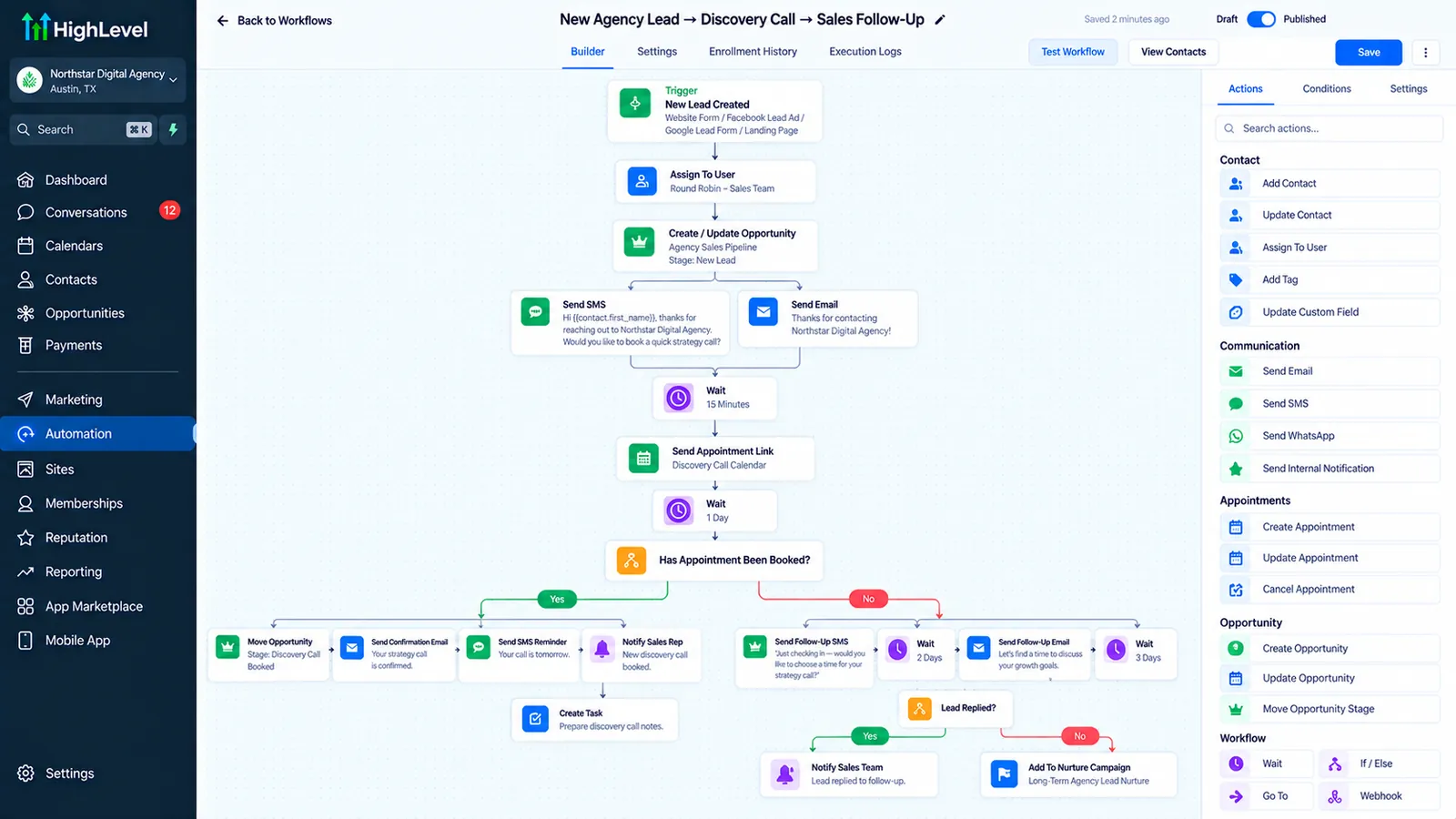
Structured onboarding automation, built as a workflow triggered when a deal moves to “closed-won,” typically includes:
- A welcome sequence confirming the engagement, timeline and what happens next
- Automated kickoff call scheduling, so the first real touchpoint happens quickly rather than waiting on manual coordination
- A structured request for access and credentials needed to start work (ad accounts, website, analytics, existing tool logins), collected once, clearly, instead of piecemeal over several back-and-forth messages
- A first-30-days check-in sequence specifically, separate from the ongoing account-management cadence that follows afterward
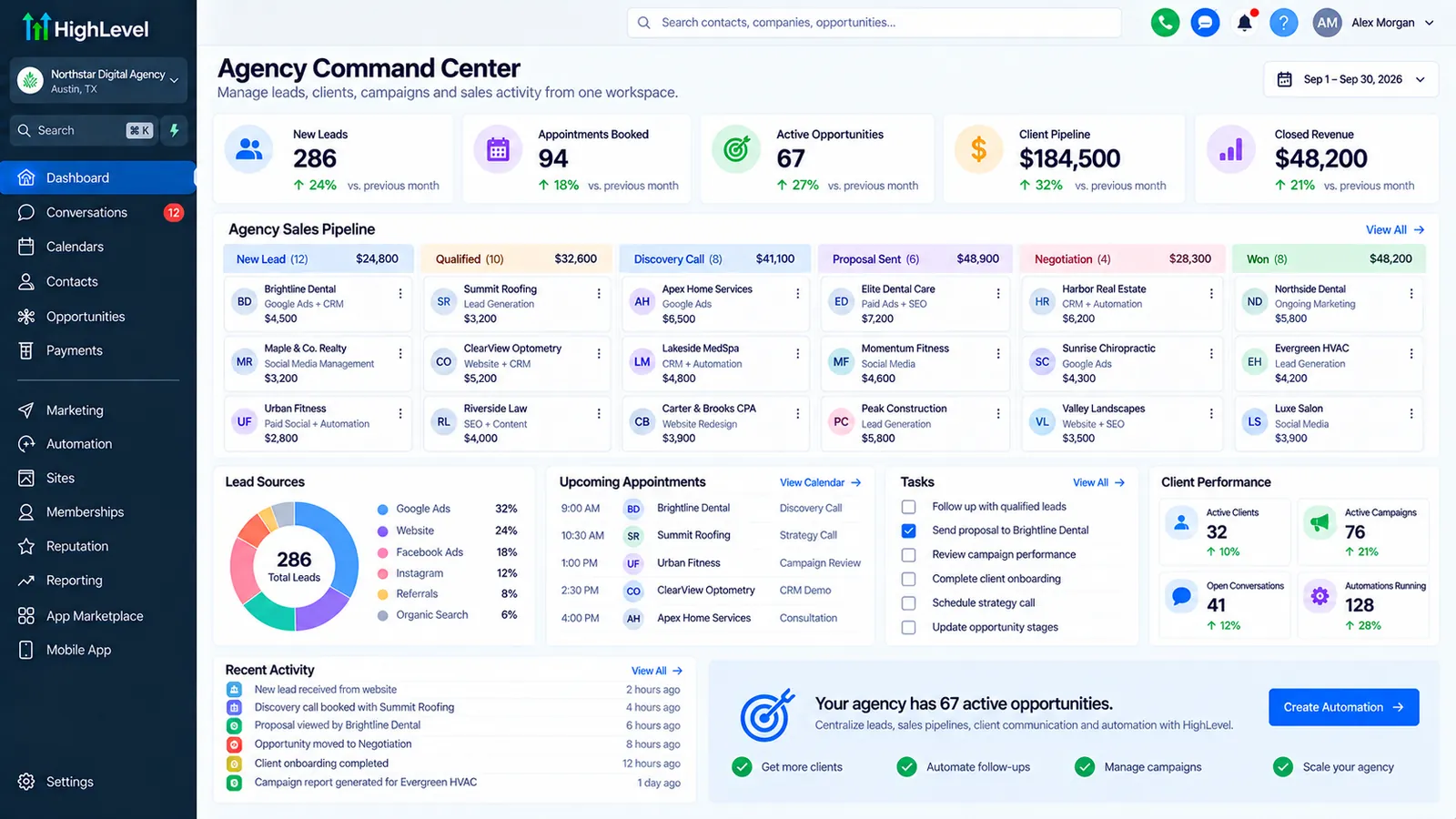 *Illustrative example of a GoHighLevel pipeline view for an agency's own client acquisition process, built with a fictional agency name and invented sample data for demonstration purposes only, not an actual client account.*
Flagging churn risk before a client says anything
By the time a client explicitly says they’re considering leaving, the relationship has usually already been deteriorating for a while. Behavioral signals tend to show up earlier: missed or repeatedly rescheduled check-in calls, declining engagement with performance reports (not opening them, no questions, no reaction to results either way), or a shift in tone across support interactions.
A client-health score built from custom fields — a point value for each signal, tracked and updated by workflow actions as events happen — gives account management a single number to watch instead of a gut feeling. A workflow that flags an account once the score crosses a threshold triggers a proactive call or a candid check-in about satisfaction, before the client has fully decided to leave rather than after. Given how much a 5-point retention swing is worth at typical agency margins, a handful of accounts caught this way in a year can cover the entire cost of building the workflow many times over.
The agency’s own pipeline, stage by stage
Lead capture
A form fill, ad click or referral link triggers an automated acknowledgment and a task for the sales owner, tagged by source so a referral, a paid click and a content download aren't treated the same way from the first message.
Stops leads from sitting unseen in a shared inboxDiscovery-call qualification
A short quiz-style form or automated text exchange captures budget range, current tools and timeline before the calendar link unlocks, routing clearly poor-fit leads to a nurture sequence instead of a live call slot.
Keeps unqualified calls off the calendar in the first placeProposal follow-up
Removes the single most commonly dropped agency sales stage: a pipeline-stage change on the proposal itself starts the check-in cadence automatically, so a busy week never means a deal quietly went cold.
Recovers deals that would otherwise quietly go coldOnboarding automation
A signed client triggers a welcome sequence, automated kickoff scheduling, a single structured request for access and credentials, and a first-30-days check-in cadence separate from ongoing account management.
Protects the fragile first-month impression before real results landClient-health scoring and churn-risk flagging
Missed check-in calls, declining report engagement and shifting support-ticket sentiment feed a custom-field score that flags an account once it crosses a threshold, prompting proactive outreach before the client decides to leave.
Surfaces at-risk accounts before a client says anythingWhich GoHighLevel triggers and workflow mechanics actually build this?
The pipeline described above isn’t a single feature toggle — it’s a handful of workflows chained to specific triggers, and knowing which trigger fits which stage is most of the build. Lead capture uses a form-submission or webhook trigger, which fires the moment a lead fills out a form on the agency’s own site or a paid landing page; the workflow attached to it sets a source tag via a custom field, creates a task for the sales owner, and sends the automated acknowledgment, all in the same run. Qualification typically uses a calendar-gating pattern: the booking link itself sits behind a form, and a workflow only unlocks or sends the real booking link once the qualifying form’s conditions are met, with a separate branch routing anyone who doesn’t qualify into a longer nurture sequence instead.
Proposal follow-up runs off a pipeline-stage-change trigger — specifically, the moment a deal or opportunity moves into a “proposal sent” stage, which starts a multi-step workflow with delays between each step (typically two to three days apart) rather than firing all its messages at once. Onboarding automation uses the same stage-change trigger pattern on a “closed-won” transition, kicking off a workflow with several branches running in parallel: one branch handles the welcome sequence and kickoff scheduling, another handles the access/credential request, and a third sets a delayed check-in task for 30 days out.
Client-health scoring is the most mechanically involved piece, because it isn’t one workflow — it’s several small workflows, each triggered by a different event (a missed calendar appointment, a report email going unopened past a certain window, a support-ticket tag), each incrementing or decrementing a numeric custom field that represents the health score. A separate workflow watches that custom field and fires an internal notification once it crosses a defined threshold. None of this requires GoHighLevel’s more advanced scripting or API access — it’s built entirely from native workflow triggers, actions and custom fields — though an agency comfortable with GoHighLevel’s API can extend it further, pulling in signals (like actual campaign performance data) that don’t originate inside GoHighLevel itself.
Where does a referral program fit into this pipeline?
Referrals deserve their own tracked path rather than getting folded into the generic lead-capture workflow, because a referred lead behaves differently from a cold one and converts at a meaningfully higher rate in most agencies’ own experience, even without a formal published benchmark to cite for that specific claim. A simple, workflow-driven referral system — a unique tracked link or form per existing client, tagging any lead that comes through it with both a source tag and the referring client’s name — does two things at once: it routes the referred lead into a shorter, warmer qualification sequence (skipping some of the colder-lead qualifying questions, since trust is already partly established), and it creates a trigger point for saying thank you to the referring client, automatically, when the referral converts.
That second part matters more than it sounds. A referral program that never acknowledges the referring client teaches clients, subtly, that referring doesn’t get noticed — and referral volume tends to fade quietly rather than stop all at once, which makes the drop-off easy to miss until someone actually checks the source-tag reporting described earlier. A workflow that fires an automated (but genuinely personal-feeling, using merge fields) thank-you message, or flags a task for a partner to make a personal call, the moment a referred lead closes, keeps that loop visible and reinforces the behavior instead of letting it fade.
GoHighLevel vs. a dedicated CRM for the agency’s own pipeline
An agency evaluating this build reasonably asks whether GoHighLevel is actually the right tool for its own internal sales and retention pipeline, separate from the question of whether it’s the right tool to resell to clients. The honest answer is that it depends on what the agency is already running. An agency that already owns a GoHighLevel account for client work gets this build essentially free of additional software cost — it’s an extra sub-account and some workflow-building time, not a new subscription. An agency with no existing GoHighLevel presence, evaluating purely on merits for its own internal CRM, is choosing between GoHighLevel and something like HubSpot or Pipedrive on the same criteria covered in how to choose a CRM: team size, process complexity, and what the platform needs to integrate with.
Where GoHighLevel specifically wins for an agency’s own use is the tight loop between marketing execution and CRM: an agency running its own ads, landing pages, email and SMS through the same platform its sales pipeline lives in avoids the integration work a separate marketing stack plus a separate CRM would require. Where it’s a weaker fit is deep, native sales forecasting and multi-stage approval workflows for larger deal sizes — features a dedicated CRM built specifically around enterprise sales tends to handle more natively. For most agencies under roughly 50 people running a fairly linear sales-to-delivery motion, that tradeoff favors GoHighLevel, especially if client work already lives there; for a larger agency with a genuinely complex, multi-stakeholder sales process, it’s worth a real comparison rather than defaulting to GoHighLevel just because the agency already owns a license.
What goes wrong when agencies build this themselves?
A few failure patterns show up often enough to name specifically. The most common is building the workflows once, during a slow week, and never revisiting them — a snapshot or workflow built to match the sales process as it existed six months ago quietly drifts out of alignment as the actual process changes, and nobody notices until a lead falls through a gap that used to be covered. The fix isn’t more automation; it’s a named owner and a quarterly review of the actual pipeline against what the workflows assume is happening.
The second is over-scoping the health score. It’s tempting to track every available signal — every email open, every login, every support interaction — into the client-health score, but a score built from too many low-signal inputs becomes noisy and gets ignored, the same way an alert system that cries wolf too often gets muted. Two or three genuinely predictive signals (missed calls, unopened reports, and support-ticket sentiment, as described above) tend to outperform a longer list that dilutes the signal with noise.
The third is skipping the qualifying step because it feels like friction the sales team doesn’t want to add. In practice, a short qualifying form or automated exchange filters out a meaningful share of calls that would have gone nowhere anyway, and the sales team’s discovery-call time is usually the scarcest resource in a growing agency — protecting it is worth the small amount of friction a qualifying step adds for a genuinely interested lead.
Keeping the agency’s own pipeline separate from client sub-accounts
An agency that both runs its own sales pipeline on GoHighLevel and resells or configures GoHighLevel for clients needs clean separation between the two. The agency’s own sales and client-management data should live in its own sub-account, distinct from the sub-accounts provisioned for (or resold to) clients.
Mixing them might seem convenient early on, but it creates real reporting confusion and unnecessary access-control exposure as both the agency’s own client roster and its resold account base grow. It’s a problem that’s straightforward to avoid from the start and considerably more annoying to untangle later.
Where this fits with the rest of an agency’s GoHighLevel use
Running the agency’s own acquisition and retention pipeline on GoHighLevel is a genuinely separate project from configuring it for clients, but the two aren’t unrelated. An agency that understands its own sales and retention automation deeply tends to build noticeably better client setups, because it’s living with the same platform’s real strengths and limitations on its own business. The GoHighLevel agency setup guide is the companion piece for the technical build side, and GoHighLevel implementation services is where to start if you’d rather have either project scoped by someone who’s built both before.